


NumPEx launches a new monthly webinar series: first session on 28 September
A new monthly webinar series is starting this September, bringing together the NumPEx community and a broader scientific audience around key results and emerging challenges in scalable scientific computing.
Starting in September 2026, NumPEx will host a monthly webinar series, with sessions held on the last Monday of each month, from 1:30 to 2:30 PM (CEST).
The series will provide an opportunity to highlight scientific results, technological developments and strategic topics connected to the challenges addressed by NumPEx. Designed for a broad audience, the webinars will combine scientific content with accessible context, helping participants understand how each topic contributes to the wider objectives of the NumPEx programme.
The sessions will feature one or more speakers, depending on the topic, and will be open to the wider scientific community. Some webinars will focus on recent scientific achievements, while others will explore strategic issues such as the role of AI in high-performance computing or approaches towards more sustainable computing.
First webinar: scaling inverse problem resolution across multiple nodes and GPUs
The series will kick off on 28 September 2026 with a session by Benoît Malézieux on:
Scaling inverse problem resolution across multiple nodes and GPUs with a simple API
Scientific imaging pipelines are increasingly relying on neural networks, opening up new possibilities for solving complex inverse problems. However, training these models on very large images and volumes can require substantial computational resources and presents significant engineering challenges.
This first webinar will introduce a distributed framework integrated into the open-source DeepInv library, designed to facilitate training and inference across multiple GPUs and computing nodes through a simple and user-friendly API.
The approach will be illustrated through large-scale inverse problems, where individual data samples can contain hundreds of millions of pixels or voxels. The session will provide an opportunity to explore how distributed computing can help scale these approaches while making the underlying technology more accessible to researchers.
Beyond the technical aspects, the webinar will put these developments into perspective within the broader challenges of scalable scientific computing, one of the key areas addressed by NumPEx.
28 September 2026 – 1:30-2:30 PM (CEST)
Online – Zoom
Free access – no registration required


Thomas Hérault explores fault tolerance in HPC at COMPAS 2026
At COMPAS 2026, Thomas Hérault highlighted the critical role of fault tolerance in the future of High-Performance Computing, from theoretical foundations to practical solutions for next-generation HPC systems.
From 30 June to 3 July 2026, COMPAS 2026, the French-speaking conference on parallelism, architecture and systems, brought together researchers, young scientists and industry representatives in Anglet, France. Organised by the Université de Pau et des Pays de l’Adour (UPPA) and the LIUPPA laboratory, the conference provided a forum for discussing the latest developments in parallel computing, computer architectures and systems.
The 2026 edition featured a rich scientific programme covering topics ranging from high-performance computing and hardware architectures to distributed systems, cloud computing, energy efficiency, artificial intelligence and resilience. With 128 participants, 67 presentations and 20 posters, COMPAS 2026 highlighted the vitality of the French-speaking research community and fostered exchanges between established researchers, early-career scientists and industry.
Thomas Hérault: addressing fault tolerance at scale
One of the conference’s three invited lectures was delivered by Thomas Hérault (Inria Bordeaux). His keynote, “Fault-Tolerance in High Performance Computing: from Theory to Practice”, addressed one of the key challenges facing the future of large-scale computing: how to design HPC systems and software that can continue operating efficiently despite increasingly frequent hardware and software failures.
As computing systems grow towards Exascale, the sheer number of components involved makes resilience and fault tolerance increasingly important. Thomas Hérault’s presentation explored this challenge from fundamental theoretical concepts through to their implementation in modern HPC environments, including next-generation MPI systems.
His contribution also complemented a dedicated Fault-tolerance session, which he chaired during the conference. The session brought together research on fault tolerance for task-based runtime systems, fault detection in programmable switches and distributed-system resilience, illustrating the breadth of approaches being developed to make future HPC infrastructures more robust.
Why it matters for NumPEx
Resilience is a fundamental challenge for Exascale computing. As systems become larger and more heterogeneous, the probability of failures during long-running scientific simulations increases, making fault tolerance an essential component of the Exascale software stack.
Through its support of COMPAS 2026 and the participation of researchers such as Thomas Hérault, NumPEx contributes to strengthening the French HPC community and to promoting exchanges around the software challenges that will shape the next generation of computing systems.
By connecting research on algorithms, runtime systems, architectures and applications, events such as COMPAS provide an important forum for anticipating these challenges and developing the technologies required to make Exascale computing reliable, efficient and usable for scientific applications.

Saint-Girons V: NumPEx highlights the future of numerical computing at the HPC frontier
From 29 June to 3 July 2026, the Saint-Girons V conference brought together researchers from across the HPC and numerical computing communities to discuss the algorithms, architectures and emerging technologies shaping the future of scientific computing.
The fifth edition of the Saint-Girons Conference took place in Saint-Girons, in the Ariège region of France, from 29 June to 3 July 2026. Building on a conference series that dates back to 1994, Saint-Girons V brought together researchers working at the intersection of high-performance computing, numerical mathematics, scientific applications and computer architectures.
This year’s programme reflected the rapidly evolving HPC landscape. Discussions covered numerical linear and multilinear algebra, numerical optimisation, PDE solvers, AI for scientific computing, HPC for AI, quantum computing, mixed and low-precision computing, randomized algorithms and low-rank approximation. The conference highlighted how advances in algorithms and numerical methods must go hand in hand with developments in hardware and computing architectures.
NumPEx at Saint-Girons V
As part of the programme, Alfredo Buttari (CNRS–IRIT) presented “The NumPEx French PEPR Research Program”, introducing the programme, its objectives and its contribution to the development of the French Exascale software ecosystem. His presentation took place during the conference’s HPC and numerical linear algebra sessions, alongside contributions from leading researchers from academia, research organisations and industry.
The conference provided a particularly relevant setting to present NumPEx. Its focus on the interaction between algorithms, applications and computing architectures closely mirrors one of the central challenges of the transition towards Exascale: developing software and numerical methods capable of fully exploiting increasingly
Looking towards the next generation of HPC
Saint-Girons V also provided a broader perspective on the transformations underway in scientific computing. The rise of AI and massive data processing, the emergence of quantum computing and the move towards new precision regimes are opening new research directions while raising fundamental questions about performance, portability, energy efficiency and numerical reliability.
For NumPEx, these discussions contribute to the wider effort to anticipate the software challenges of the Exascale era, foster connections between the different communities involved in scientific computing and support the development of innovative numerical methods and software.
Beyond the scientific programme, the conference’s informal format encouraged exchanges between researchers and helped create new opportunities for collaboration — a long-standing feature of the Saint-Girons meetings.
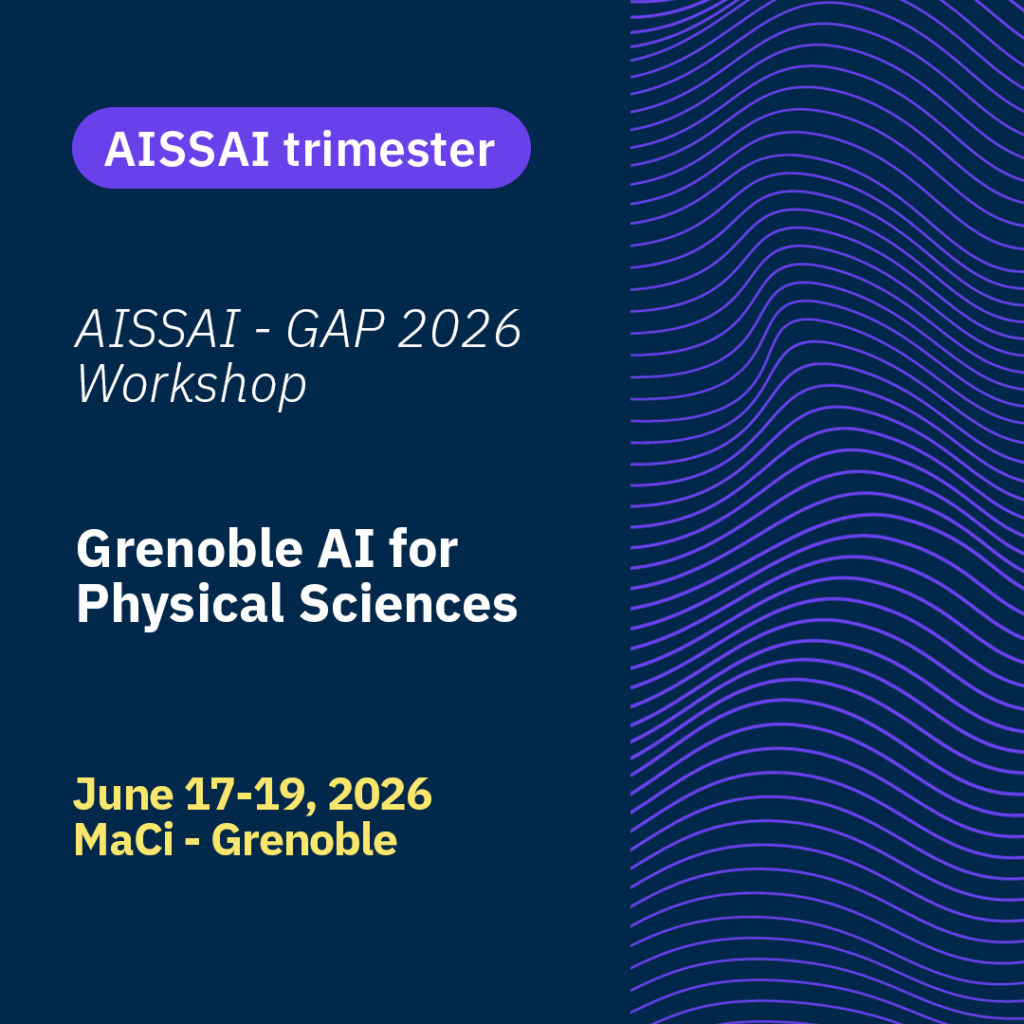
AISSAI/GAP 2026: Exploring the Convergence of AI and High-Performance Computing for Science
From 17 to 19 June 2026, Grenoble hosted AISSAI/GAP 2026, bringing together researchers working at the intersection of artificial intelligence, high-performance computing and the physical sciences.
From 17 to 19 June 2026, the AISSAI/GAP 2026 – Grenoble AI for Physical Sciences workshop brought together an international community of researchers at the Maison de la Création et de l’Innovation (MaCI), Université Grenoble Alpes. The event was organised as part of the thematic trimester “HPC and AI convergence at the Exascale era”, led by the CNRS AISSAI Center in connection with PEPR NumPEx.
Following the success of its first edition in 2024, GAP 2026 focused on the rapidly developing interface between artificial intelligence and the physical sciences. The workshop explored key research directions including inverse problems, simulation-based inference, data-driven scientific discovery and foundation models for science, while highlighting advances in theory, algorithms and high-performance computing.
The three-day programme featured keynote talks from leading international experts and covered a broad range of scientific applications, including climate and geosciences, astrophysics, neuroscience and engineering systems. Among the invited speakers were researchers from EPFL, Stanford University, ETH Zurich, the University of Tübingen, Inria, CNRS and several international universities.
A dedicated poster session provided an opportunity for participants to present ongoing research and exchange ideas across disciplines. Particular attention was given to work exploring the synergies between AI and HPC in the Exascale era, a central challenge for the future of scientific computing.
For NumPEx, GAP 2026 contributed to a broader effort to foster dialogue between the HPC and AI communities and to explore how their convergence can transform scientific computing at Exascale. By bringing together experts from different fields, the workshop helped identify new opportunities for collaboration and highlighted the methodological and computational challenges that will shape the next generation of AI-enabled scientific applications.
AISSAI Gap 2026 workshop

Result of the NumPEx call for action
The NumPEx program is launching its first call for projects to support advances in high-performance computing (HPC), high-performance data analysis (HPDA) and artificial intelligence (AI). Our France 2030 research program aims to develop software capable of operating future exascale machines, and to prepare the main scientific and industrial application codes.
This call is structured around three axes:
- Emerging AI methods, algorithms and software for scientific computing and HPC for AI.
- Programming models adapted to accelerated architectures.
- Workflows for scientific data analysis, with the SKA project as a use case.
DAIMOS - Distributed AI Model training Optimization at Scale
Project leader: Julien Herrmann, CNRS researcher
Training large-scale AI models presents major challenges, particularly regarding computational
cost and energy efficiency. This project addresses these issues by developing a new software stack
for large-scale deep learning, based on a close integration of algorithmic advances, systems-level
optimization, and concrete application use cases. It directly supports the priorities of the NumPEx
PEPR program on HPC for AI.
SAGe-HPC - Smart strateGies for multi-fidelity optimization in Exascale HPC Environments
Project leader: Laëtitia Giraldi, Inria researcher
The SAGE-HPC project aims to develop a scalable, open, and interoperable software platform for multifidelity
optimization of complex physical problems in exascale high-performance computing (HPC) environments.
Solving such optimization problems poses a major scientific challenge due to the complexity
of the physical phenomena involved and the computational cost associated with high-fidelity simulations.
To overcome this challenge, the project leverages both the coordinated use of variable-fidelity models —
where simplified, low-cost models guide the exploration of the solution space, and high-fidelity models are
used selectively to refine the results — and the massive exploitation of exascale HPC resources, enabling
large-scale parallel processing of these approaches.
KOKTAILS - Kokkos by translation and interoperability leveraged in software
Project leader: Stéphane de Chaisemartin, IFPEN engineer
The KOKTAILS project aims to enhance the portability of simulation software on Exascale computing
architectures, by contributing to the development of a sovereign software stack adapted to
GPU-based supercomputers. It is part of the NumPEx PEPR strategy and contributes to French
digital sovereignty in high-performance computing (HPC). It includes the development of scalable
middleware to guarantee performance portability on various GPU architectures, including European
processors such as SiPearl Rhea. The project thus contributes to the transition of existing applications
to Exascale computing, through the creation of an open-source ecosystem in line with
European sovereignty policy.
ASTRA - Advanced FR-SRC Tasks and Resource Allocation
Project leader: Marc-Antoine Miville-Deschênes, CNRS researcher
This research project addresses the critical transformation underway in radio astronomy, driven by next-generation observatories such as LOFAR2.0 and the SKA. These instruments are producing massive, heterogeneous datasets distributed across multiple sites, which cannot be efficiently handled using legacy data processing approaches. The project aims to overcome these structural bottlenecks by developing a unified, scalable digital platform that federates HPC, cloud, and object storage resources. It will support the execution of complex workflows (including AI-based processing) across heterogeneous infrastructures through modern containerization technologies. Key principles such as data provenance, reproducibility, and energy-aware computing will be integrated to support both interactive and automated scientific workflows.

InPEx 2026: Shaping the Post-Exascale Future Through International Collaboration
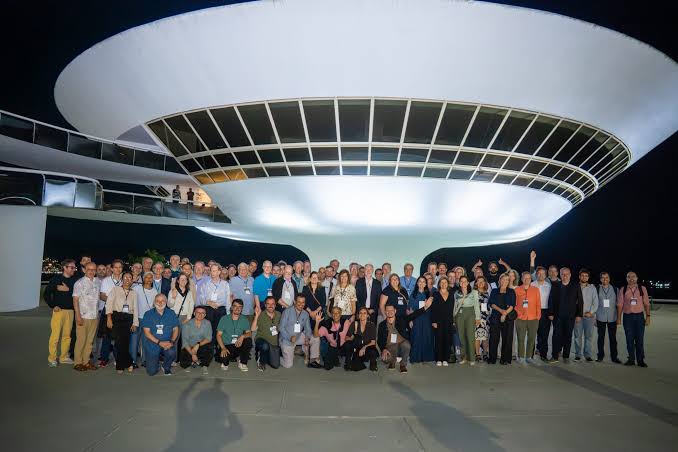
From 22 to 25 April 2026, the InPEx community gathered in Niterói, Brazil, bringing together around 120 HPC experts from Europe, Japan, the United States and Latin America to explore the challenges and opportunities of the Post-Exascale era.
The International Post-Exascale Project (InPEx) held its 2026 workshop from 22 to 25 April in Niterói, near Rio de Janeiro, Brazil. The workshop brought together around 120 experts from the international HPC community, representing research organisations, universities and national computing initiatives from Europe, Japan, the United States, Latin America and the Caribbean.
Launched in 2023 as an international initiative, InPEx was initiated by the French PEPR NumPEx to foster international collaboration and co-design around the future of high-performance computing. The initiative brings together major HPC communities and programmes, including NumPEx in France, EuroHPC in Europe, the US Exascale Computing Project ecosystem and Japan’s national supercomputing initiatives.
Exploring the key challenges beyond Exascale
The 2026 workshop focused on the major technological and scientific challenges emerging as HPC moves towards and beyond the Exascale era.
Five major topics structured the discussions: HPC/AI convergence, GenAI and software engineering, the computing continuum and data management, experimentation with large AI models for science, and international roadmapping. Quantum computing was also addressed as part of the broader convergence between emerging computing paradigms.
The workshop provided a unique opportunity to compare regional strategies and ongoing initiatives. Representatives from Japan, the United States, Europe and Latin America presented their national and regional roadmaps, including developments around AI for Science, quantum computing, AI Factories and future HPC infrastructures.
Dedicated working sessions then brought participants together to address concrete research and technology challenges. Discussions explored topics such as AI and HPC co-design, scalable training and inference, heterogeneous architectures, low-precision computing, AI-driven software engineering, scientific foundation models and the integration of computing resources across the computing continuum.
From shared challenges to international roadmaps
A central objective of InPEx is to move beyond the exchange of information and build shared visions and concrete international collaborations. The Niterói workshop continued work initiated during previous InPEx meetings and contributed to the development of common roadmaps for the Post-Exascale era.
The international roadmapping discussions addressed the future of heterogeneous computing, energy efficiency and the convergence of AI, HPC and quantum computing. The workshop also explored how international communities could coordinate their efforts to address common technological challenges and support future research and funding strategies.
NumPEx at the heart of the international Post-Exascale dialogue
For NumPEx, InPEx represents a major international extension of its mission to anticipate the software and technological challenges of Exascale and beyond.
By initiating and supporting InPEx, NumPEx is helping to create a global forum where HPC communities can share experience, identify common challenges and co-design the technologies needed for the next generation of scientific computing. The initiative also strengthens links between European, American, Japanese and Latin American HPC ecosystems.
The 2026 workshop in Brazil marked another important step in this process, transforming discussions around Post-Exascale computing into concrete international working groups, roadmaps and collaborative activities.
The 2026 annual meeting of Exa-DI
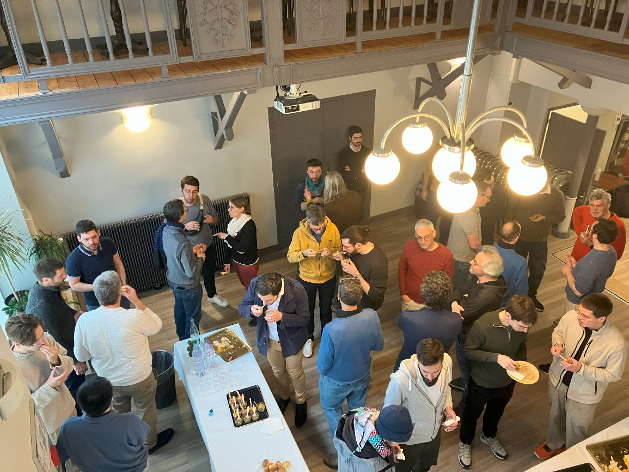
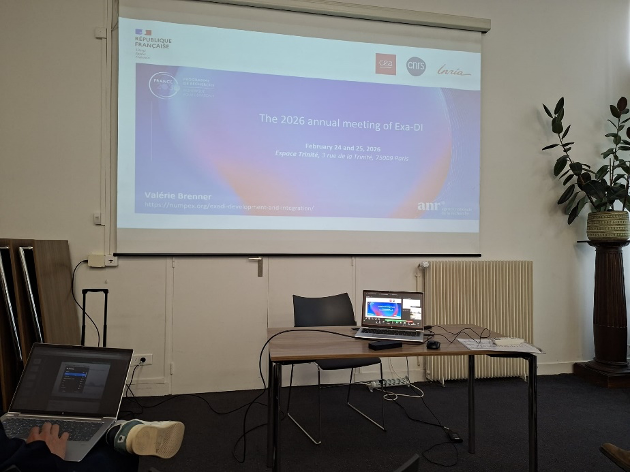
The 2026 annual meeting of the Exa-DI project (Development and Integration) of the PEPR NumPEx took place on February 24 and 25th at Espace Trinité, Paris.
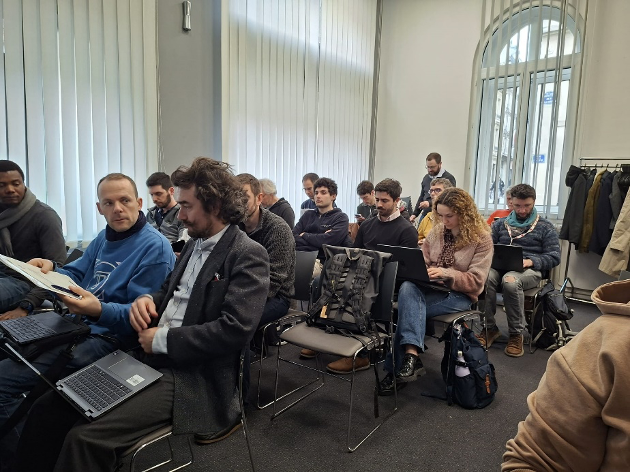
This face-to-face meeting brought together for one day the complete Exa-DI team – the members of each Work Package (WPs), the Program manager of the CDT, the CDT members, the leaders of the co-design/co-development Working groups (WGs) who are member of the Application Demonstrators (ADs) teams, members of others NumPEx projects of the (Exa-MA, Exa-SofT, Exa-DoST and Exa-AToW), as well as representatives from the national (IDRIS, TGCC, CINES) and regional (GriCAD,) computing centres and experts.
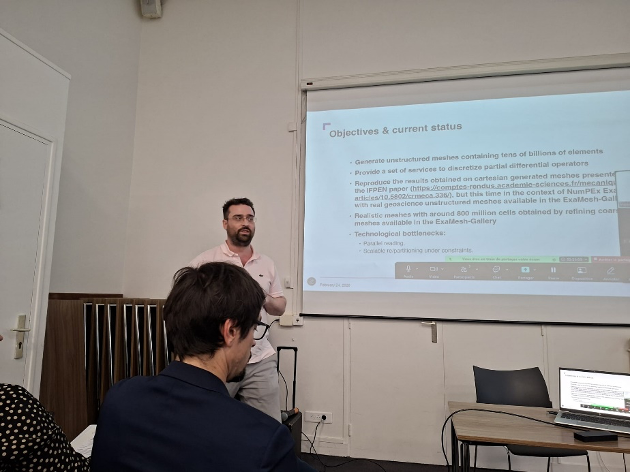
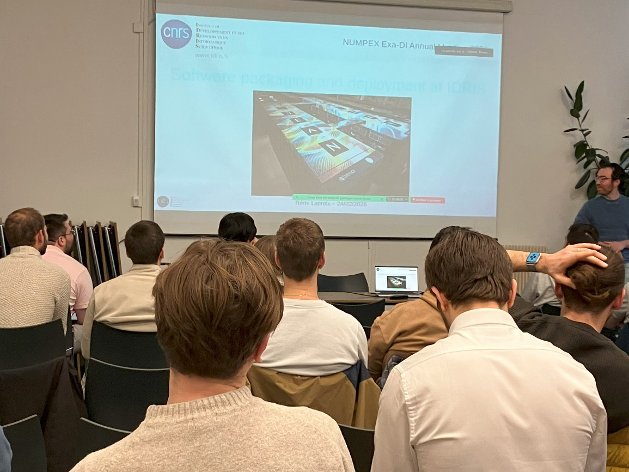
This meeting was first an opportunity to create the momentum between all the stakeholders involved in the co-design/co-development processes and second tostrengthen their alignment. This is one of the main objectives of the Backlog sessions in which each co-design/co-development working groups (WGs) presented their roadmap for the next 2-3 month in order to establish, coordinate and organize the engineering activities of the CDT development team. Given the importance and cross-cutting nature of the topic across NumPEx, a presentation on «Task-based programming and its applications » was given by a leading expert from the Exa-SofT project. The Software packaging and deployment session organized with the participation of a regional (GriCAD) and all national computing centres (TGCC, IDRIS and CINES) provides the opportunity to discuss about packaging solutions (e.g., modules, Spack, Guix) with the aim of supporting code developers to port and deploy applications on various architectures, and in particular on leading exascale architectures. The CDT session provide an overview of the current engineering activities of the development CDT team given through four presentations, i.e Infrastructure for Benchmarking, Guix-Based Deployment and unified Kokkos Integration, High-Performance Spectral Element Operators on GPUs and Benchmarking Large Scale Inverse Problems Resolution Algorithms with Benchopt, which was followed by general discussions. Finally, in light of the recent workshop organized by GENCI following Alice Recoque’s procurement February 17-19, 2026), where collaborations between NumPEx, Bull and AMD were discussed, a specific session on possible Exa-DI/AMD/Bull collaborations was organized to, on the one hand, give feedback on the Bull/AMD workshop and, on the other hand, discuss the actions to be implemented to identify and start collaborations with AMD and Bull.
One of main goal of this meeting has been to brainstorm all together on collaboration patterns supporting the ramp-up of the Exa-DI project and their implementation through the co-design/co-development structures set-up in Exa-DI: the CDT, the co-design/co-development WGs, the WPs, etc. A key point was to follow and check that the articulation and coordination of these different structures were carried out correctly and allowed to ensure the co-design/co-development process’s success. This is essential in order to prepare the porting of applications to exascale architectures and in particular to the next European leading exascale facility to be installed at the TGCC, Alice Recoque and open to users by the end of 2027.
This annual meeting of the project is crucial to monitor that the project was being conducted properly and to ensure the proper coordination of engineering and packaging activities within the CDT in collaboration with all the stakeholders, a key point of the co-design and co-development process.
Highlights on the different components of the co-design/co-development process such as the roadmap of the co-design/co-development WGs, the engineering activities of the CDT development team, the software packaging and deployment activities of the CDT enabling team allowed to demonstrate the paramount importance of all these different activities to implement and achieve the co-design and co-development process as well as of the collaborations in the day-to-day reseach & engineering activities. The discussions with the national and regional computing centers clarified the various current and future solutions for software packaging and deployment in the regional and national computing centers and highlighted what will need to be implemented in view of the heterogeneity of future architectures. Moreover, all participants in this session agreed to meet again in the future to keep each other informed of developments and to discuss them together. Overall, the discussions were very fruitful and showed there is a strong motivation and interest in reinforcing collaborations between all the stakeholders involved in the co-design/co-development processes, and avoiding as much as possible silos & work in isolation.
Tuesday, 24 February 2026
- Introduction
by Valérie Brenner, CEA research scientist - Backlog session
by Jérôme Charousset, CEA engineer- Roadmap Working group (WG) 1
by Henri Calandra, Expert numerical methods and High Performance Computing at TotalEnergies - Roadmap WG2
by Julien Vanharen, Inria research scientist - Roadmap WG3
Maxime Delorme, CEA research scientist - Roadmap WG4
Thomas Moreau, Inria research scientist
- Roadmap Working group (WG) 1
- Programmation par tâches et ses applications
by Samuel Thibault, professor at Bordeaux University - Sofware packaging and deployment session
by Benoît Martin, Sorbonne University research scientist- Software packaging and deployment in Exa-DI
by Benoît Martin, Sorbonne University research scientist
and Bruno Raffin, Inria research scientist - Software packaging and deployment at GriCAD
by Pierre-Antoine Bouttier, CNRS engineer - Software packaging and deployment at TGCC
by Xavier Delaruelle, CEA manager and Laurent Nguyen, CEA engineer - Software packaging and deployment at IDRIS
by Remi Lacroix, CNRS engineer - Software packaging and deployment at CINES
by Gabriel Hautreux, HPC expert at CINES
- Software packaging and deployment in Exa-DI
Wednesday, 25 February 2026
- CDT session
by Félix Kpadonou, CEA research scientist- Infrastructure for Benchmarking
by Jérôme Charousset, CEA engineer - Guix-Based Deployment and unified Kokkos Integration
by Aurélien Dauteuil, CEA engineer - High-Performance Spectral Element Operators on GPUs
by Alexandre Roger, CNRS - Benchmarking Large Scale Inverse Problems Resolution Algorithms with Benchopt
by Benoit Malézieux, CNRS research scientist
- Infrastructure for Benchmarking
- AMD collaborations session
by Jérôme Bobin, CEA research scientist
Attendees
- Juliette Antonczack, Exa-MA, Université de Strasbourg
- Alexis Badel, Inria
- Rémi Baron, Exa-DI, CEA
- Baptiste Besnard, CNRS
- Julien Bigot, Exa-DI, Inria
- Jérôme Bobin, Exa-DI, CEA
- Pierre-Antoine Bouttier, CNRS
- Thomas Bouvier, Exa-DI, CEA
- Eric Boyer, Genci
- Valérie Brenner, Exa-DI, CEA
- Henri Calandra, AD, TotalEnergies
- Ansar Calloo, Exa-MA, CEA
- Mathieu Certenais, Exa-AToW, Université Rennes
- Aurélien Citrain, Inria
- Jérôme Charousset, Exa-DI, CEA
- Javier Cladellas, Exa-MA, Université Strasbourg
- Ludovic Courtes, Exa-DI, Inria
- Aurélien Dauteuil, Exa-DI, CEA
- Xavier Delaruelle, CEA
- Romain Denelle, EDF
- Maxime Delorme, AD, CEA
- Etienne Decossin, EDF
- Triem Phan Dinh, Exa-DI, CNRS
- Romain Garbage, Exa-DI, Inria
- Damien Gradatour, Exa-DoST, CNRS
- Virginie Grangirard, Exa-DoST, CEA
- Loïc Guoarin, Exa-MA, École Polytechnique
- Gabriel Hautreux, Université de Montpellier
- Skander Khiari, Exa-DI, CEA
- Chai Koren, EDF
- Félix Kpadonou, Exa-DI, CEA
- Rémi Lacroix, CNRS
- Pierre-François Lavallée, CNRS
- Guillaume Lechantre, Genci
- Benoît Malézieux, Exa-DI, CNRS
- Benoît Martin, Exa-DI, CEA
- Marc Antoine Miville-Deschênes, CNRS
- Thomas Moreau, GT IA, CEA
- Laurent Nguyen, CEA
- Augustin Parret-Freaud, Safran Tech
- Bruno Raffin, Exa-DI, Inria
- Alexandre Roger, Exa-DI, CNRS
- Pascal Tremblin, CEA
- Samuel Thibaut, Exa-SofT, Inria
- Jean-Pierre Vilotte, Exa-DI, CNRS
- Julien Vanharen, AD, Inria
© PEPR NumPEx

Trans Numériques 2026
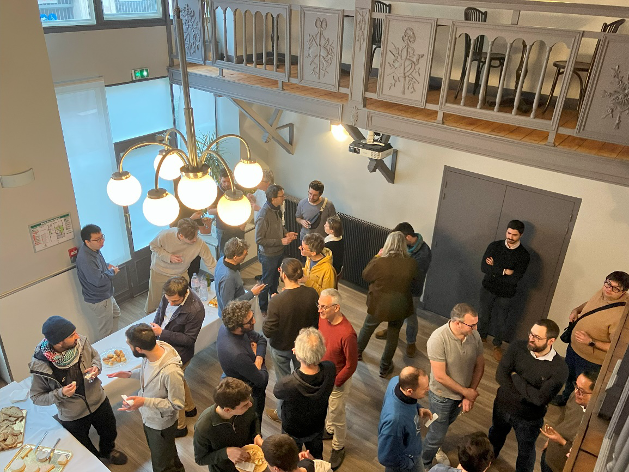
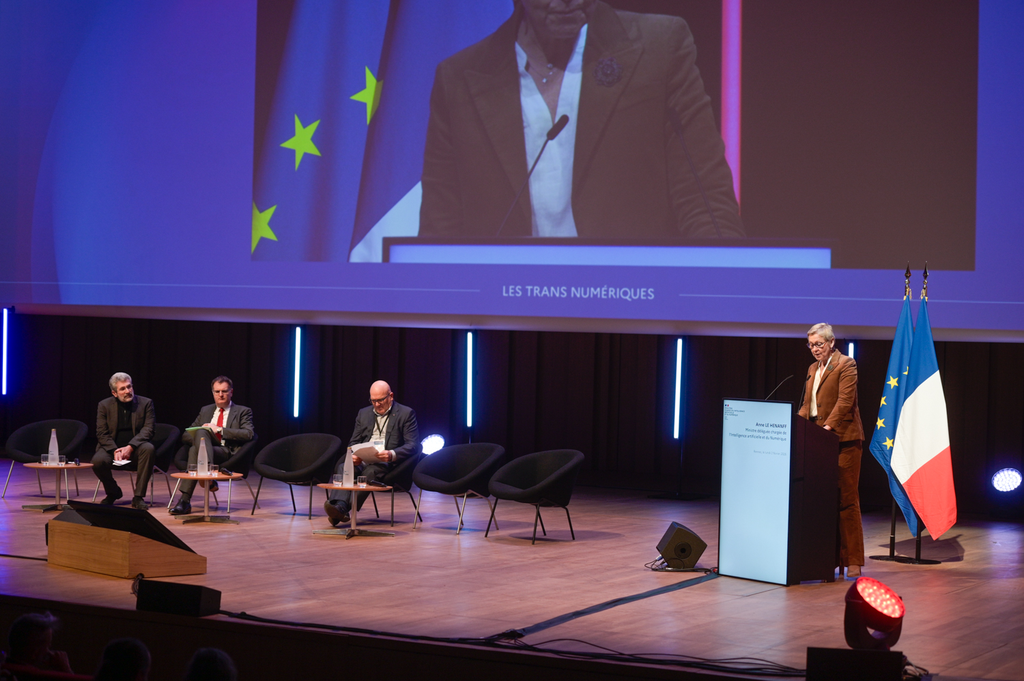
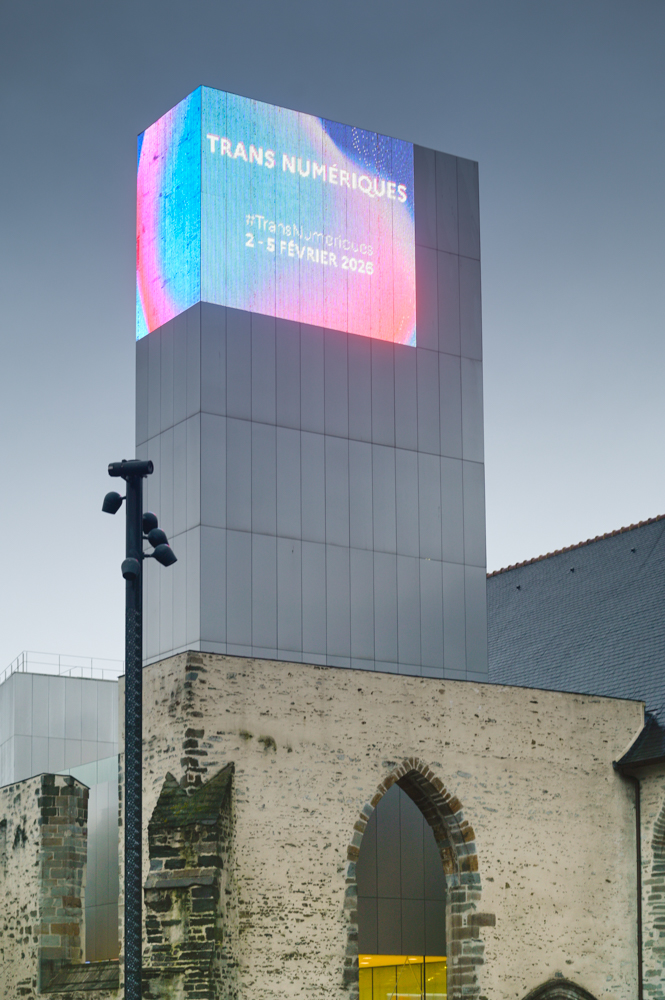
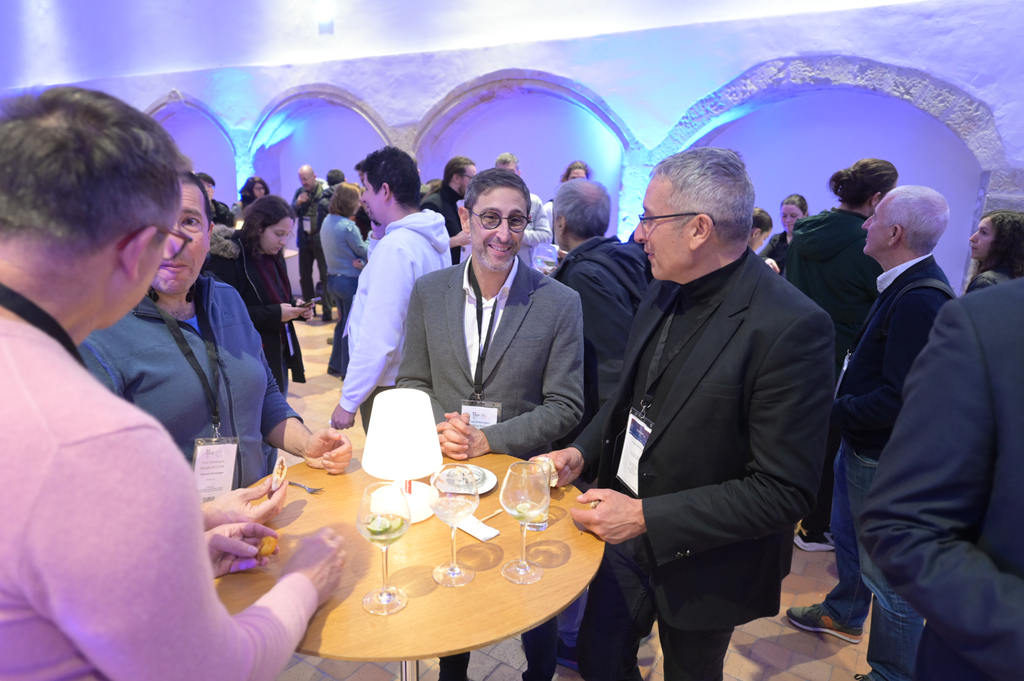
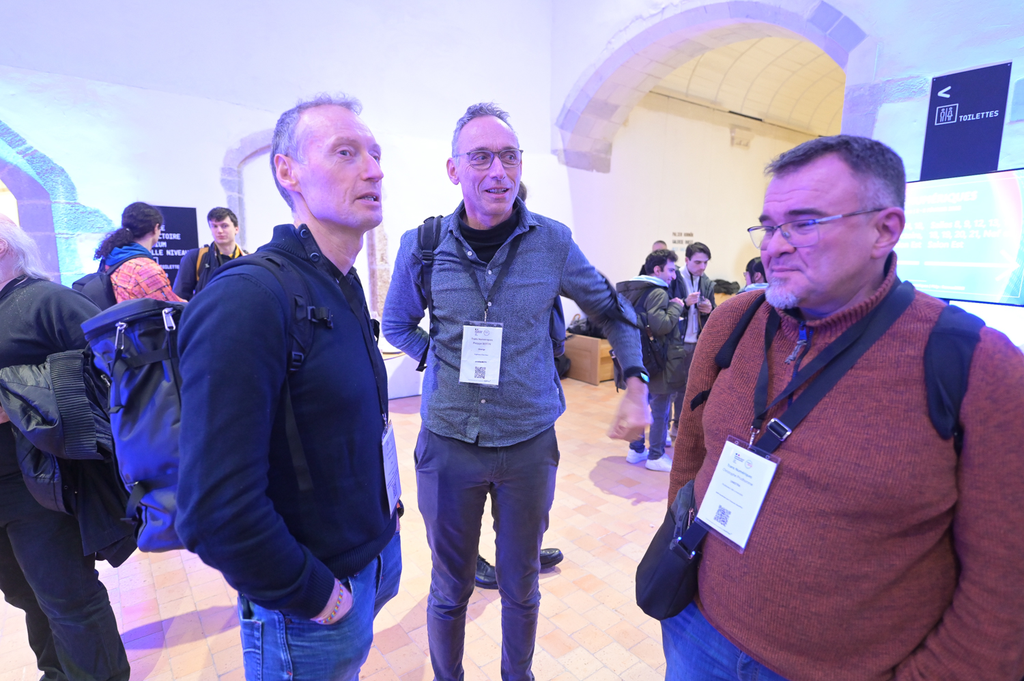
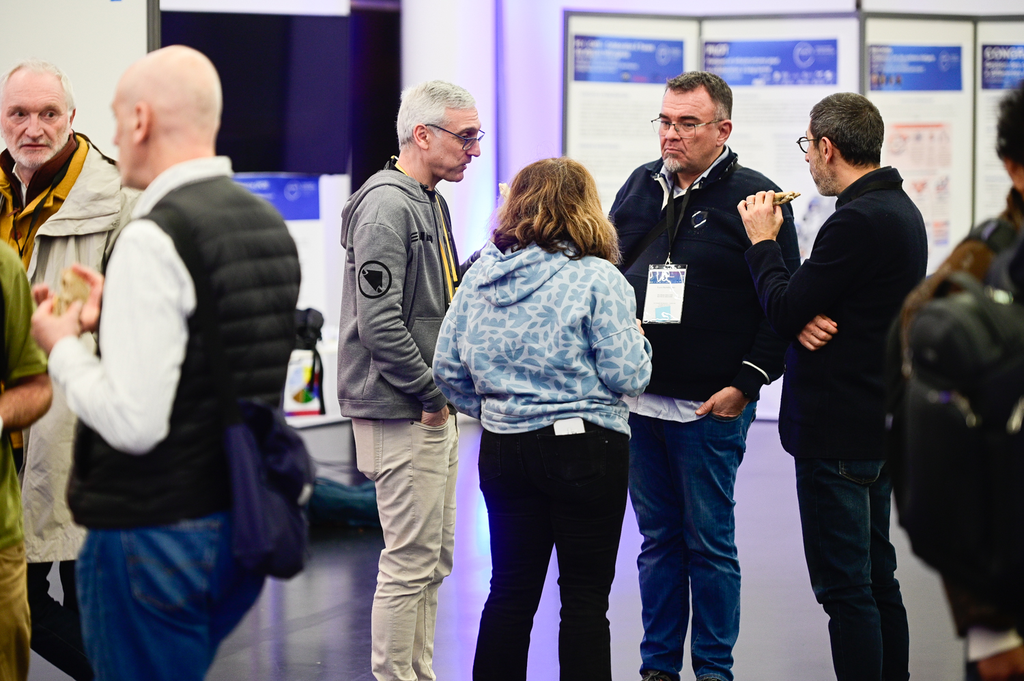
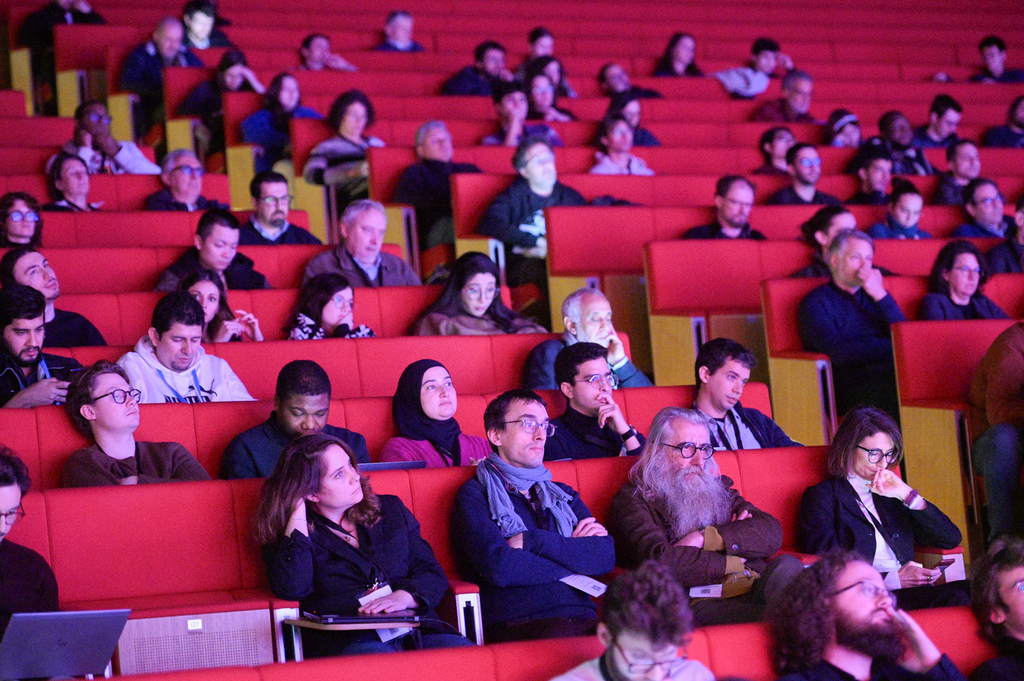
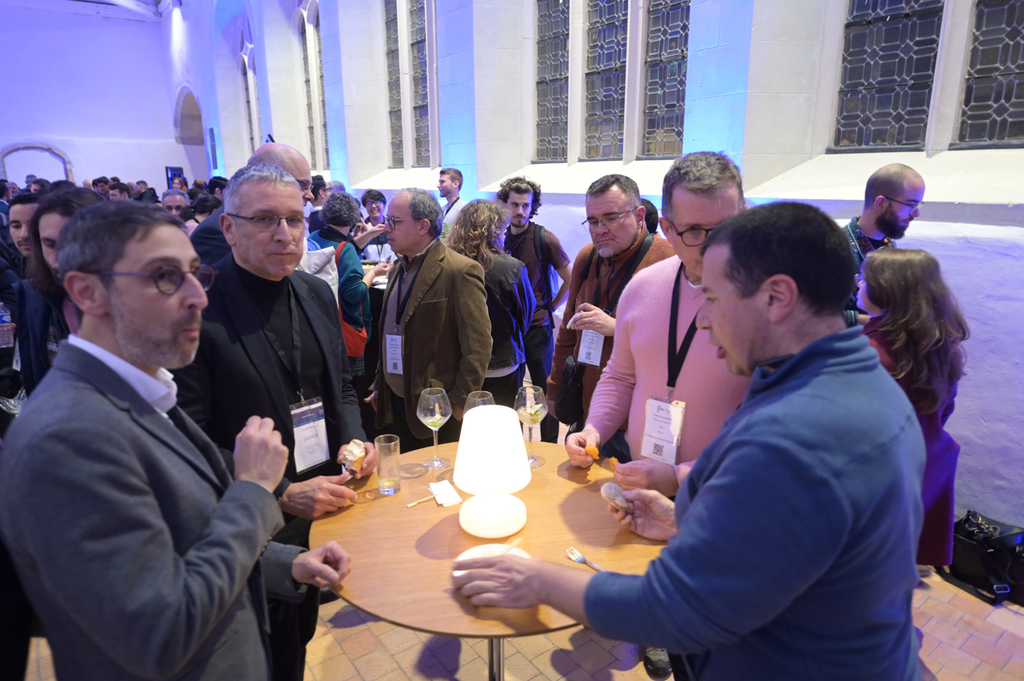
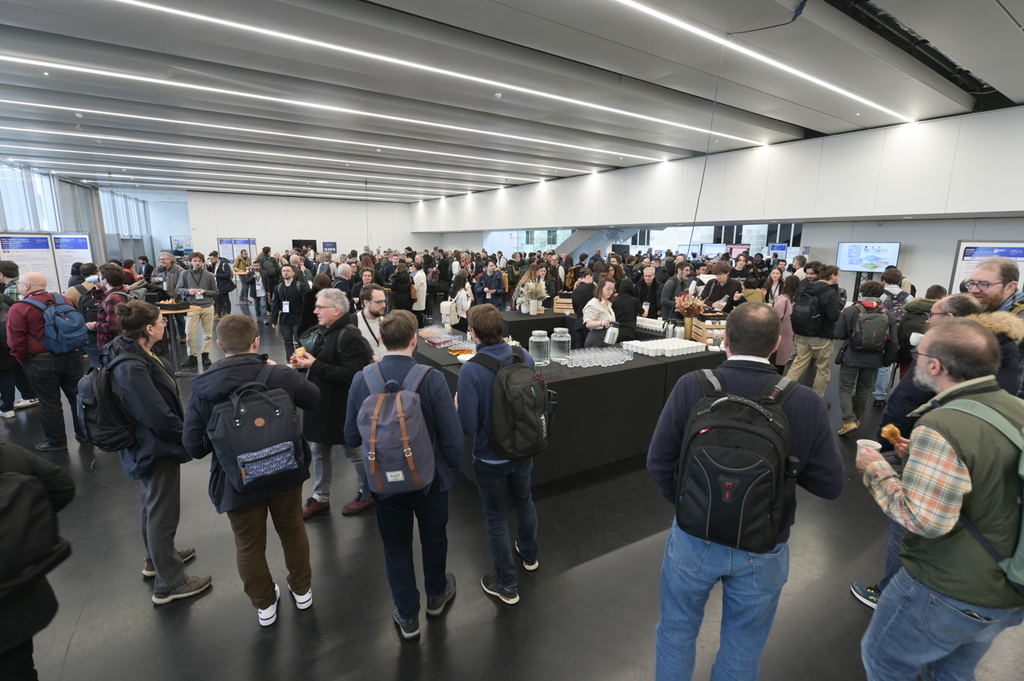
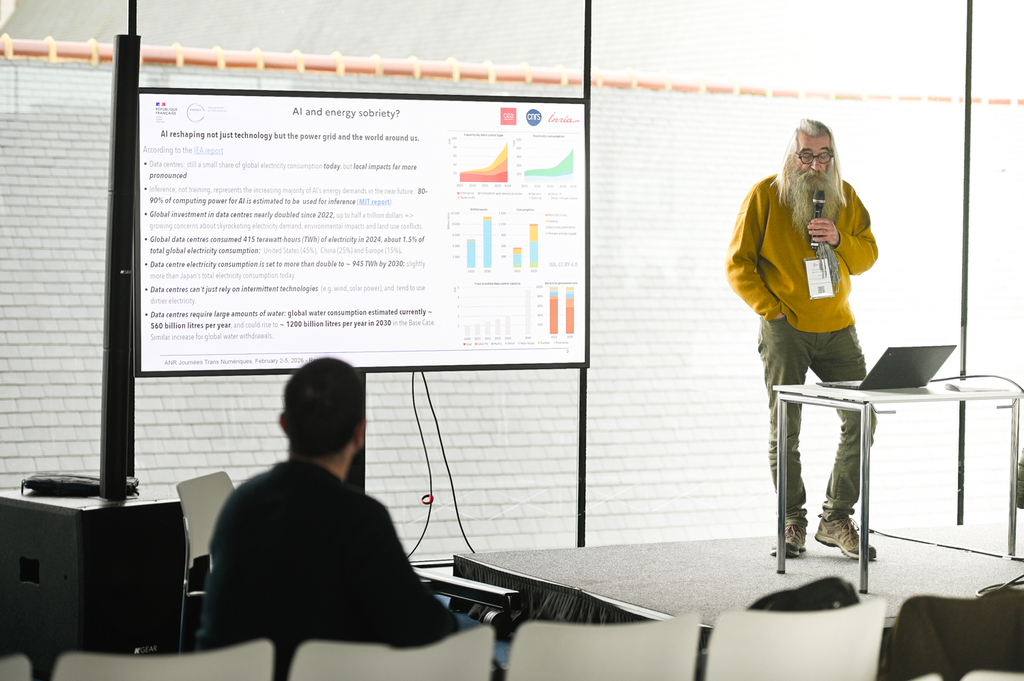
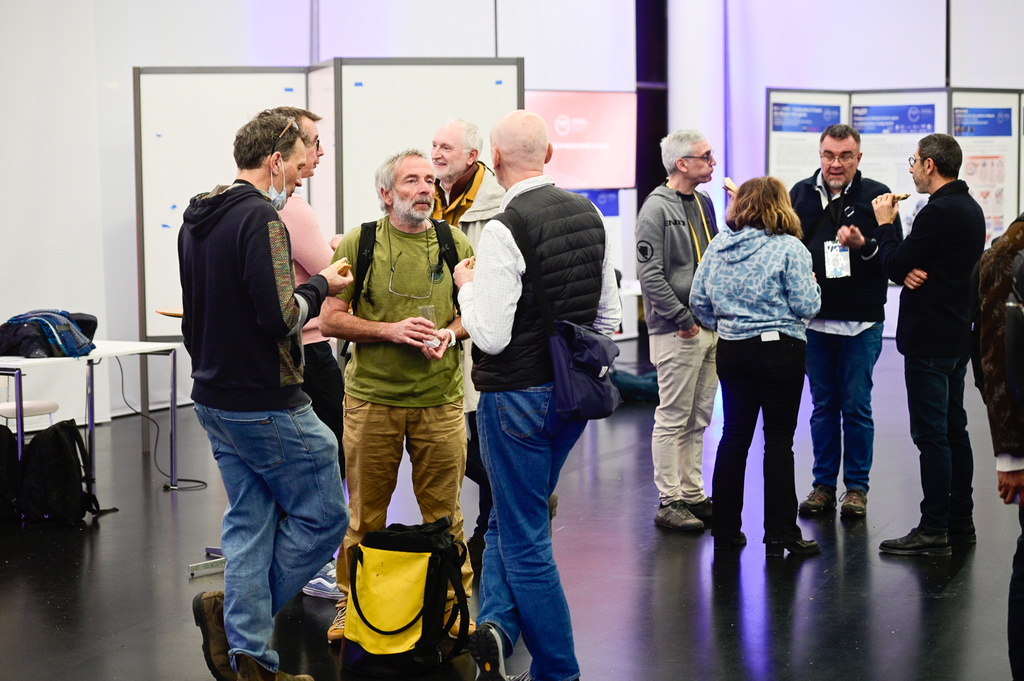
The PEPR NumPEx was proud to participate in the first edition of Trans Numériques! Thirteen PEPRs gathered from 2 to 5 February at the Couvent des Jacobins in Rennes to share scientific advances and challenges relating to performance, security, frugality and the societal impact of the digital continuum.
This event was an opportunity for NumPEx to come together to reflect on the programme’s next milestones, particularly on three major themes: IA and HPC convergence, software ecosystem and digital continuum. At the same time, this event provided an opportunity to exchange ideas with other PEPRs and share inter-PEPR projects with the digital community.
Finally, we are really proud of Méline Trochon and Théo Jolivel, NumPEx PhD students, who represented NumPEx in the ANR video and shared their fresh perspective on the event!
NumPEx program
Tuesday, 3 February 2026
- Introduction to the NumPEx only sessions
- IA and HPC convergence
- Software ecosystem
- Digital continuum
Wednesday, 4 February 2026
- IA and HPC convergence – workshop
- Software ecosystem – workshop
- Digital continuum – workshop
Thursday, 5 February 2026
- Workshop restitution
© Thomas Crabot
The ANR movie of the event
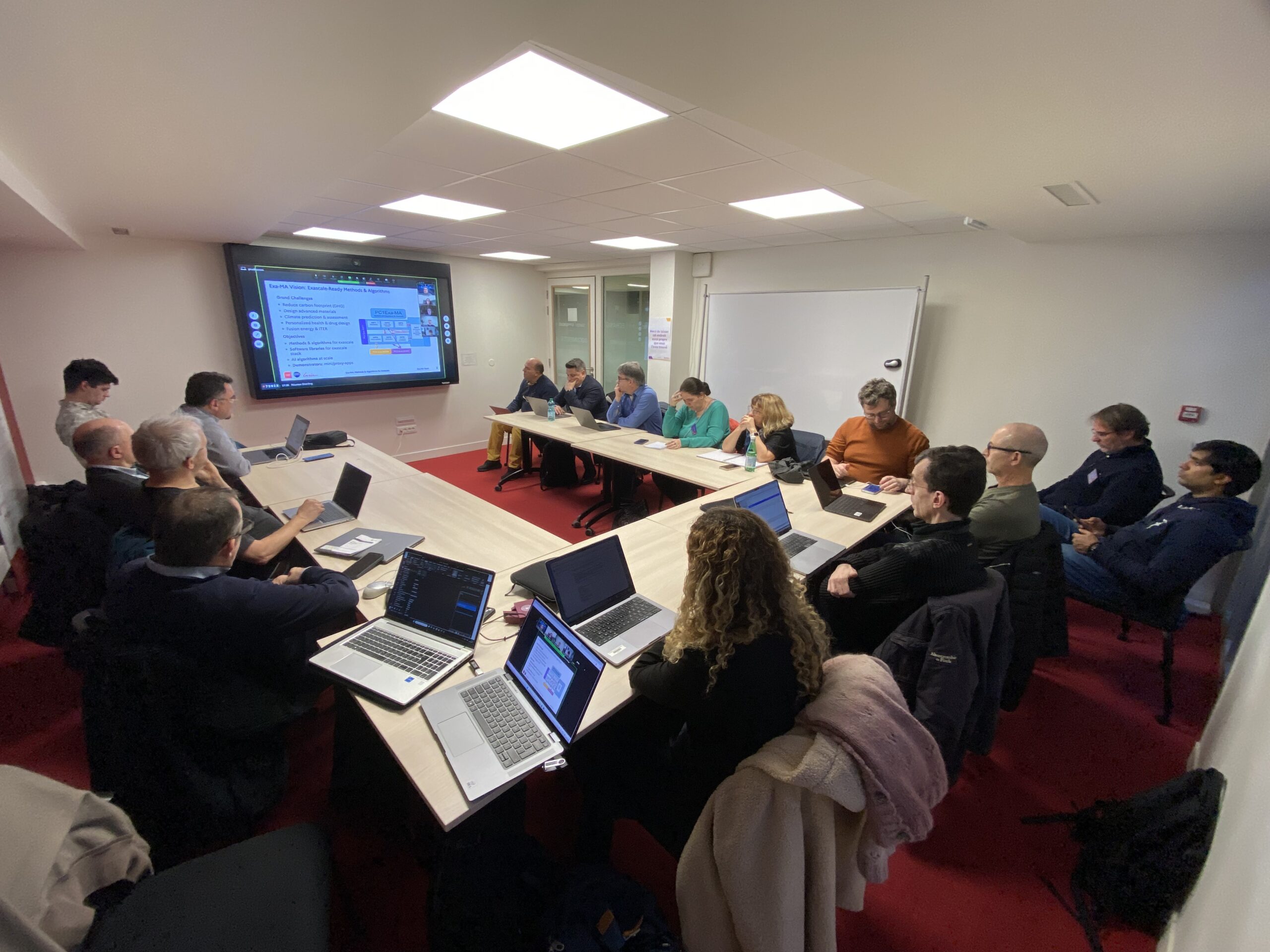
The 2026 annual meeting of Exa-MA
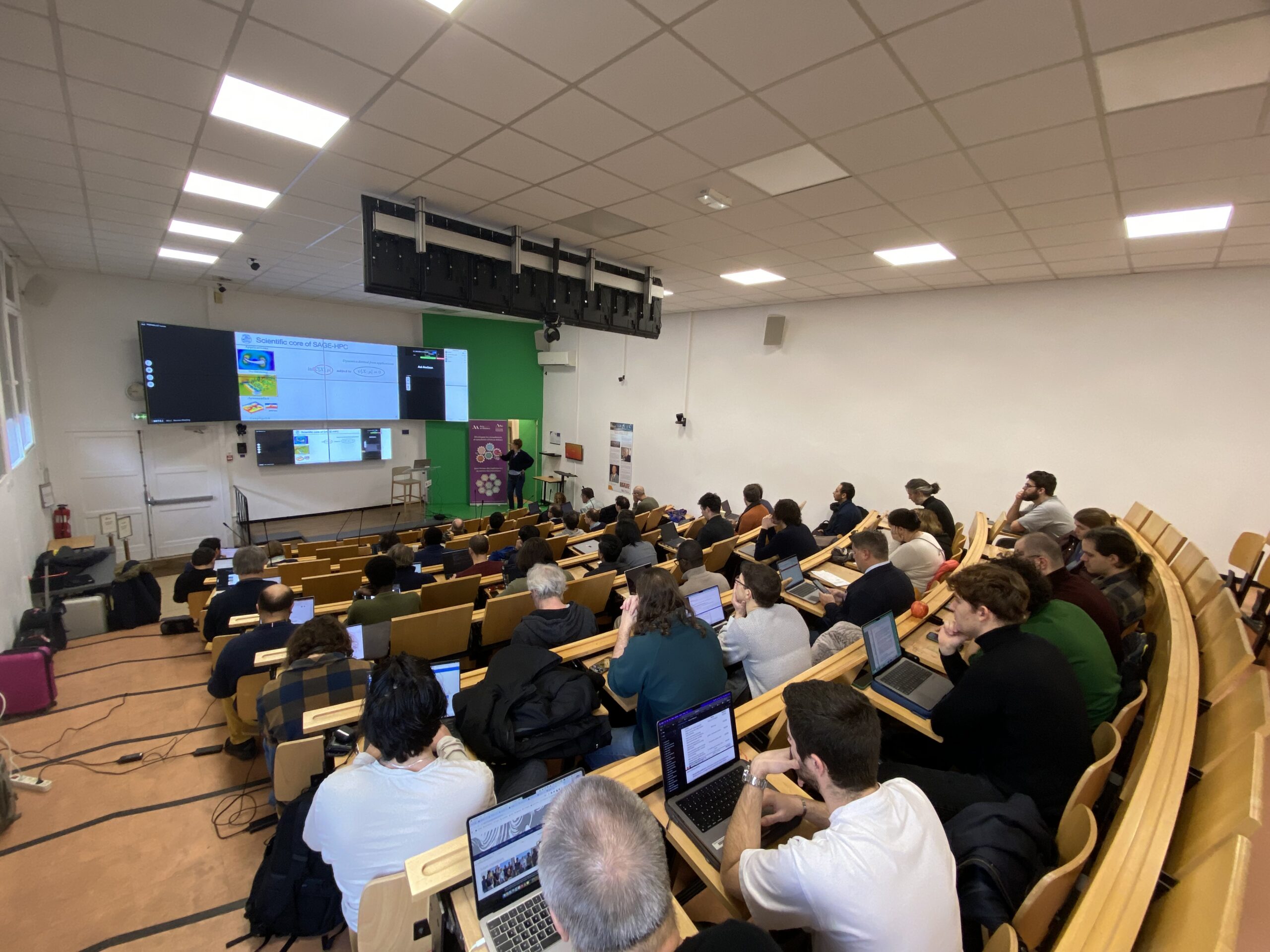
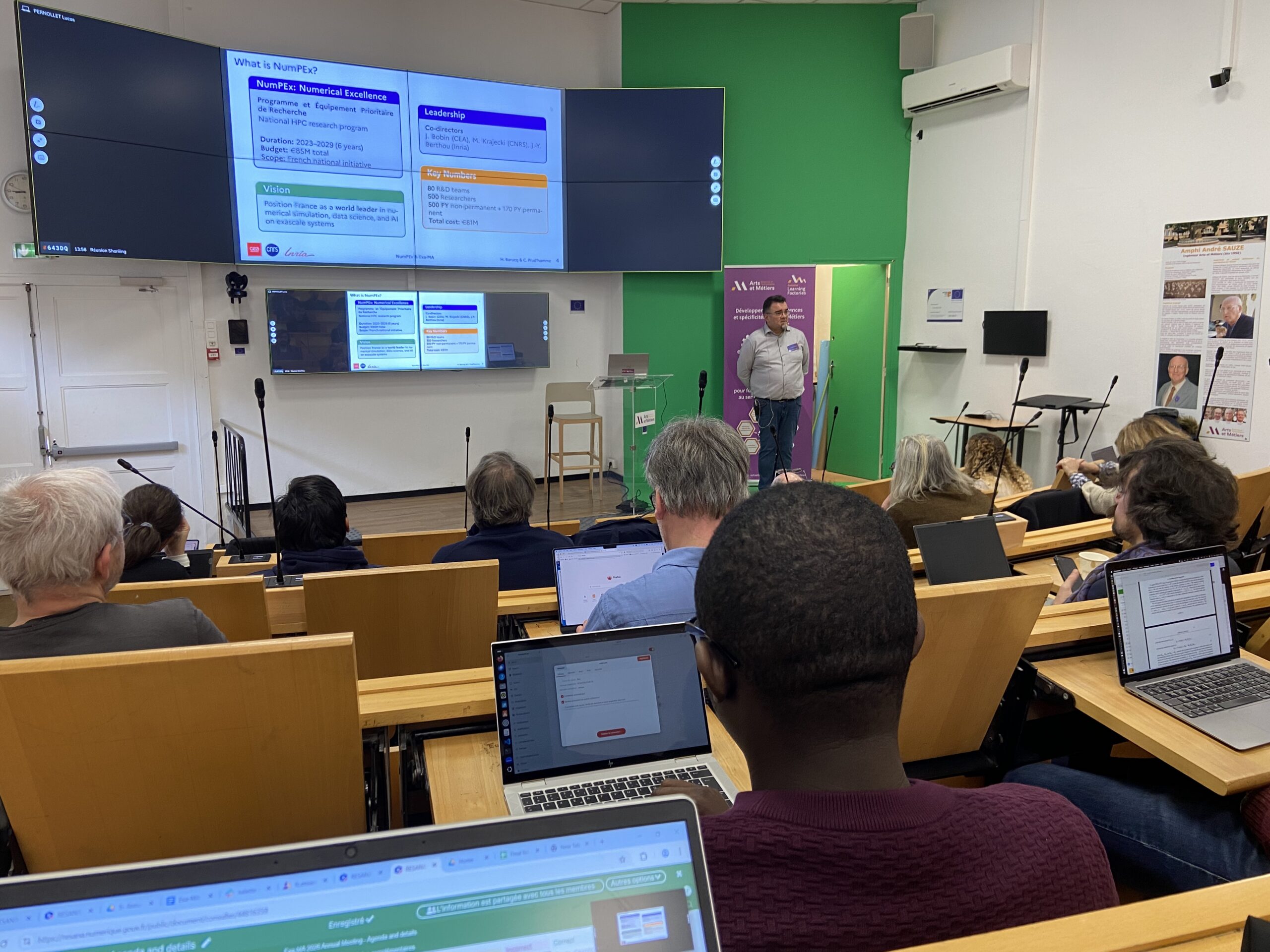
The 2026 Exa-MA Annual Assembly held at Arts et Métiers ParisTech (Aix-en-Provence) from 19 to 21 January, 2026, highlighted the project’s central role in France’s NumPEx initiative. It focused on preparing the software stack for the “Alice Recoque” exascale supercomputer.
Exa-MA aims to revolutionize methods and algorithms for exascale scaling: discretization, resolution, learning and order reduction, inverse problem, optimization and uncertainties. We are contributing to the software stack of future European computers.
The 3rd Exa-MA General Assembly highlighted the project’s central role in France’s NumPEx initiative, preparing the software stack for the “Alice Recoque” exascale supercomputer. Key discussions focused on 2026 priorities: GPU portability, AI-driven HPC convergence, and real-time neural operators, with applications in fusion energy, climate modeling, and aeronautics. The assembly emphasized delivering sovereign, open, and reproducible solutions, while addressing challenges like AI reliability in HPC and GPU acceleration. By expanding training and demonstrators, Exa-MA is reinforcing its “French model” of collaborative innovation, bridging AI and HPC for measurable scientific and societal impact.
Monday, 19 January 2026
- General presentation of NumPEx & Exa-MA
- Presentations of WPs: progress made + scientific highlights + next steps
Wednesday, 21 2026
- Presentation of Sage-HPC (AI for HPC)
- Presentation of Daimos (HPC for AI)
- Feedbacks from WPs (intra-WP meetings + breakout sessions with frameworks):
Attendees
- Emmanuel Agullo, Inria
- Pierre Alliez, Inria
- Amaury Bélières Frendo, Unistra
- Ani Anciaux Sedrakian, IFPEN
- Brieuc Antoine dit Urban, Inria
- Juliette Antonczak, Unistra
- Mark Asch, Université de Picardie
- Hassan Ballout, Unistra
- Helene Barucq, Inria
- Jerome Bobin, CEA
- Jed Brown, University of Colorado
- Filippo Brunelli, Inria
- Ansar Calloo, CEA
- Xinye Chen, Sorbonne Université
- Javier Cladellas, Unistra
- Susanne Claus, ONERA
- Ariel De Vora, CEA
- Mohamed Doumbouya, Inria
- Pierre Dubois, CEA
- Mahmoud El khadiri, Inria
- Erik Fabrizzi, Sorbonne Université
- Vincent Faucher, CEA
- Emmanuel Franck, Inria
- Josselin Garnier, Ecole Polytechnique
- Clément Gauchy, CEA
- Christophe Geuzaine, Université de Liège
- Laetitia Giraldi, Inria
- Loic Gouarin, Ecole Polytechnique
- Arthur Gouinguenet, Inria
- Virginie Grandgirard, CEA
- Julien Herrmann, Inria
- Alexandre Hoffmann, Ecole Polytechnique
- Remy Hosseinkhan, Ecole Polytechnique
- Daria Hrebenshchykova, Inria
- Bertrand Iooss, EDF
- Vincent Italiano, Unistra
- Utpal Kiran, CEA
- Félix Kpadonou, CEA
- Philipp Krah, CEA
- Stéphane Lanteri, Inria
- Romain Le Tellier, CEA
- Benoît Malézieux, CEA
- Gilles Marait, Inria
- Jean-Baptiste Mascary, ANR
- Lois McInnes, Argonne National Laboratory
- Victor Michel-Dansac, Inria
- Mahamat Hamdan Nassouradine, CEA
- Frédéric Nataf, Sorbonne Université
- Laurent Navoret, Unistra
- Lars Nerger, Alfred Wegener Institute
- Augustin Parret-Fréaud, Safran
- Lucas Pernollet, CEA
- Raphaël Prat, CEA
- Christophe Prud’homme, Unistra
- Isabelle Ramière, CEA
- Yves Robert, ENS
- Mael Rouxel-Labbe, Geometry Factory
- Gianluigi Rozza, SISSA
- Eric Savin, ONERA
- Lukas Spies, Inria
- Alexandre Tabouret, Sorbonne Université
- El-ghazali Talbi, Université de Lille
- Tom Caruso, Inria
- Sébastien Tordeux, Inria
- Arthur Vidard, Inria
- Jean-Pierre Vilotte, CNRS


© PEPR NumPEx

C4P, a research network for the field of computing
Alfredo Buttari and Théo Mary, both NumPEx members, now lead the research network Computing: Paradigms, Parallelism, Performance, Precision (Groupement de recherche C4P).
The field of computing in computer science is undergoing rapid and disruptive changes, both at the conceptual and technological levels and in terms of the application needs of the academic and private sectors. In this context, the creation of the Research Group (GDR) Computing: Paradigms, Parallelism, Performance, Precision (C4P, pronounced [kap]) is motivated by the need to unite, structure and animate the French scientific research community in the field of computing in the broadest sense.
Computing, a field undergoing rapid transformation
The largest supercomputers have now reached exaflop scale (a speed of 1018 floating point operations per second). However, their extremely complex architecture is characterised by a very high level of parallelism and a high degree of heterogeneity in terms of computing units, memory and communication channels. Similarly, energy consumption has become a major concern, as the power consumption of these large computing infrastructures can reach several tens of megawatts.
Furthermore, while numerical simulation applications were the main use of computing centres for several decades, artificial intelligence, and more specifically machine learning, has recently come to occupy an increasing share of computing infrastructure resources. This discipline has experienced a veritable explosion in recent years, thanks in particular to the availability of computing resources that enable the training of very large models that now include billions of parameters.
Significant challenges:
In this context, marked by rapid technological changes that sometimes break with past approaches, scientific research in the field of computing is evolving. It faces significant challenges at several levels, from hardware and software to data management and numerical methods and algorithms. This can be summarised by the four ‘Ps’ in french:
- Paradigms: Design and develop emerging paradigms, such as quantum, neuromorphic, molecular, or in-memory computing, to overcome the limitations of von Neumann architecture and the end of Moore’s Law through more efficient, parallel, and frugal computing models.
- Parallelism: designing and developing algorithms, programming models and computing software capable of scaling up on modern computing infrastructures equipped with numerous heterogeneous computing units, memories and communication channels.
- Performance and energy: measuring, analysing and improving the performance of algorithms and computational software in terms of time, memory and energy consumption, taking into account the complexity and diversity of infrastructures and applications.
- Accuracy and robustness: measuring, controlling and guaranteeing the accuracy and robustness of algorithms and computational software in the face of errors, in a context where the use of low-precision arithmetic is increasingly widespread and failures are increasingly likely.
Read the original version on CNRS Informatics
© CNRS Sciences informatiques