


Exa-DI
Development and integration
Targeted project
Overview
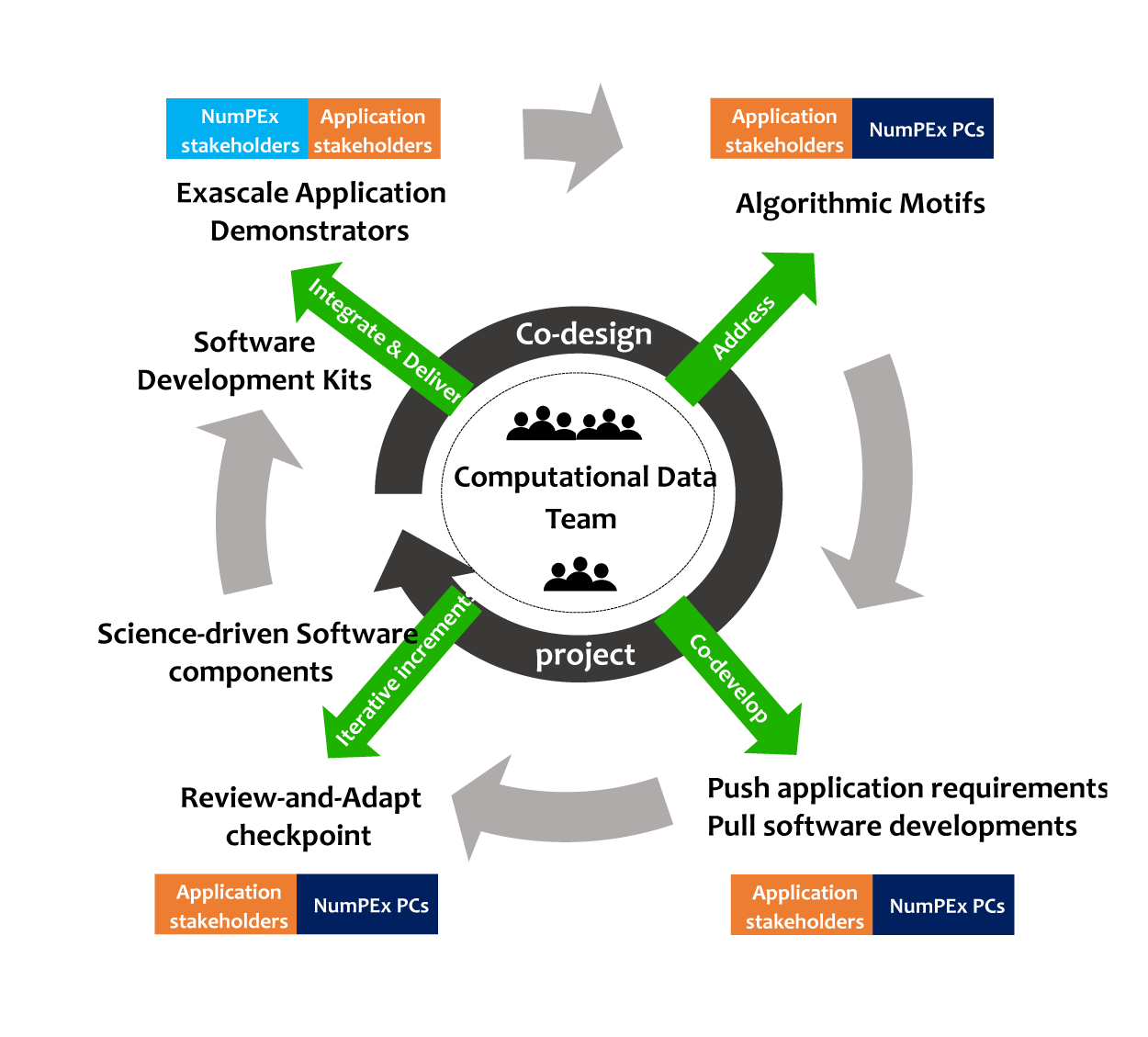
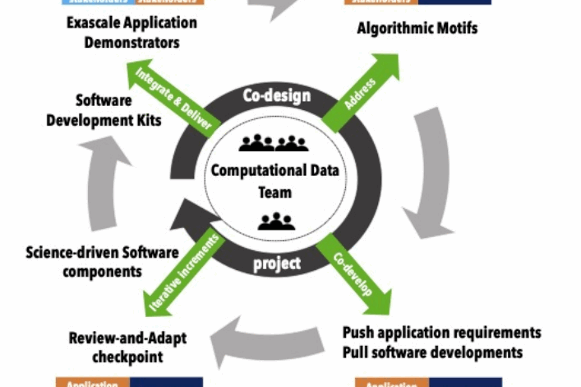
The Exa-DI project is responsible for implementing the co-design and co-development process within NumPEx to develop a software stack that enables the productive use of exascale systems. Ensuring application productivity, portability, and longevity requires improving scientific software development methods by leveraging high-quality, maintained components (libraries, frameworks, and tools). This objective is supported by a national software development and engineering team (the Computational Data Team; CDT) comprising researchers and engineers with diverse expertise. The CDT includes a development team (CDT-DT) responsible for co-developing proxy/mini-apps based on algorithmic motifs shared across multiple Application Demonstrators (ADs), and a enabling team (CDT-ET) responsible for software packaging (e.g., Guix, Spack) and deployment. CDT activities are carried out using an Agile methodology based on an iterative process; this approach is driven by application needs and centers on shared algorithmic motifs (computation, communication) as well as common packaging and deployment methodologies and technologies.
Following co-design and co-development workshops focused on the algorithmic motifs identified during the joint analysis of the Application Demonstrators (ADs), 6 working groups (WGs) led by AD team members are now active. Their co-design and CDT engineering activities are hosted in a GitLab space named NumPEx-PC5. Additionally, a web infrastructure has been established to support software integration and collaboration platforms, notably consolidating all training modules.
Partners & Organisation
Consortium & Workpackages
Focus of the Exa-DI project is to accelerate development of exascale applications, by proposing “software development kits” – based on the methods, frameworks, libraries and software components developed in the other NumPEx projects Exa-MA, Exa-SofT, Exa-DoST & Exa-AToW – that provide sustainable, performant, and portable solutions to the most important computational and communication algorithmic motifs encountered in exascale Applications Demonstrators. These motifs are addressed through proxy-apps in an iterative co-design and co-development process together with the scientific & industrial application teams.
Workpackages
Exa-DI project consists in four work-packages:
The co-design principle
Co-design working groups are an attempt to bring together in a collaborative effort:
- Applications Teams sharing similar exascale challenges,
- Individual R&D teams from the other NumPEx projects (Exa-MA, Exa-SofT, Exa-DoST, Exa-AToW) who can provide partial solutions to these challenges,
- The CDT (Computational Data Team) who is in charge of combining & integrating these partial solutions into curated "development kits" and "proxy-apps".
Working Groups
6 Working Groups led by an application team member and a referent Exa-DI:
Results to date
Results & Impact
Exa-DI activities:
- Co-analysis of ADs: 27 application demonstrators ranging a wide spectrum of computational science and engineering domains with an increasing number of hybrid AI/HPC computational workflow applications.
- Exa-DI workshops in 2023 Efficient PDEs discretisation @exascale and in 2024 Block-structured Adaptive Mesh Refinement @ exascale in 2024, Artificial Intelligence for HPC @exascale and Large-scale SKA processing workflows
Co-design and co-development Working Groups:
The WG1 is focused on specific cross-cutting algorithmic motifs and sub-motifs to improve the development of the next-generation high-order finite/spectral element software that enable a range of applications to run efficiently on exascale hardware through proxy and mini apps.
The objective of the WG2 is to develop a proxy-app demonstrating the generation/refinement of unstructured meshes with tens of billions of elements, and providing a set of services to discretize the physics-based partial differential operators and is in the process of creating, gathering and integrating the basic building blocks for this proxy-app.
In WG3, a “standardized” benchmark to evaluate and compare the performance of different AMR frameworks on various physics applications is being implemented, the challenge being to find some common solutions to the bottleneck of AMR codes .
For WG4, the challenge is to determine how to scale disctributed AI-HPC hybrid inverse and imaging workflowson large HPC infrastructure and then to identify/benchmark core ML building components to use and develop software bricks required to unlock/scale the use-cases.
Starting up: WG5 – AI-coupled HPC workflows – surrogate models @exascale and WG6 – AI-based large-scale processing workflows @exascale
Software packaging and deployment @exascale
- Strengthen and support adoption of meta build software technologies: Spack, Guix-HPC
- Develop collaborations with HPC national and regional facilities to support Spack and Guix-HPC
- Develop training materials/webinars / Hackathons on Spack and Guix-HPC and NumPeX Software catalog
- Develop and foster adoption of NumPeX software guidelines
- Foster CI and performance assessment methodologies
Exa-DI software production
Highlights
Highlight
Facilitating the deployment of HPC applications on Exascale supercomputers with Package Managers
The installation, portability, and reproducibility of parallel applications on large computing platforms have become increasingly challenging due to growing software complexity, extensive dependencies (e.g., AI frameworks), and heterogeneous hardware architectures. Current approaches based on modules employed on most supercomputers are reaching their limits, resulting in time-consuming tasks for both support teams and users. Modern software package managers are enabling a new paradigm where users can directly manage the installation of their software and dependencies.
As part of NumPEx software integration efforts, Exa-DI is advocating that user should leverage modern package managers to gain direct and fine grain control on their software stack, with a strong focus on Guix and Spack. In this context, a series of training and support events focusing on Guix, Spack, and the specifics of software deployment on supercomputers have therefore been organized and given by the Exa-DI Work Package 3. Since 2025, 7 NumPEx Tutorial Spack and Guix for beginner and advanced were delivered and 200 people were trained.
Switching to new ways of deploying software takes time. Exa-DI is always working to help users by offering training and support, packaging software, improving tools, and partnering with supercomputing centres to make the user experience better. The ambition is to have all NUMPEX-related libraries packaged with Guix and Spack, make Guix/Spack-based deployment part of every developer’s arsenal, and work with computing centers to make Guix/Spack-based user-level software deployment as frictionless as possible.
For more information:
Highlight
Toward Exascale: scaling AI-based inverse problems workflows at scale across multiple nodes and GPUs with a simple API.
- Research Goal: Develop large-scale AI-based inverse solvers and reference benchmarks for applications like CT, Cryo-ET, and Radio-astronomy.
- Technical Approach: Enable training of unrolled networks on full-scale data using multi-node and multi-GPU computing, using distributed physics, denoiser, prior and backward gradients with a simple API in the DeepInv library.
- Key Achievement: Successfully integrated with a simple API in the widely used open-source DeepInv library, and demonstrated on large-scale 3D tomography problems (500^3 voxels), previously infeasible for most methods. Benchmarked within the BenchOpt framework on Jean Day using 16 H100 GPUs (10s per sample).
- Impact of Full-Scale Learning: Removes a major limitation and opens a new area of research at realistic scales.
- Accessibility: Makes large-scale AI-based inverse problem learning accessible to a broader community beyond HPC experts.
- Future Applications: Can be extended to other models and large-scale applications, particularly in large-scale electro tomography and radio-interferometry.
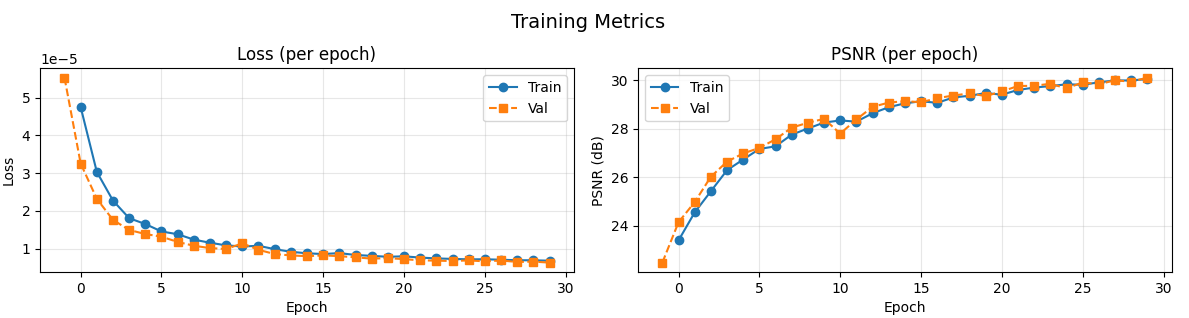
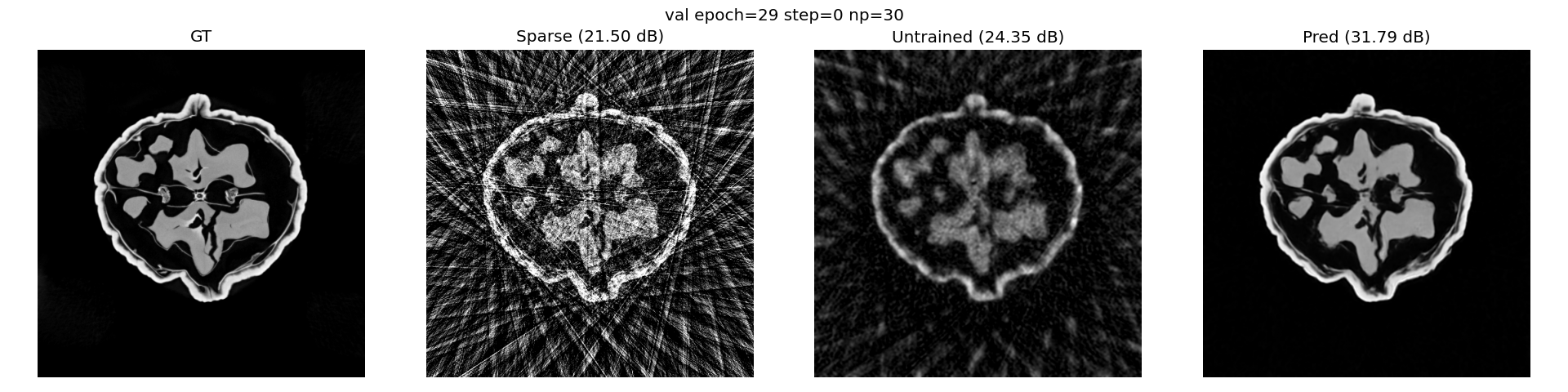
Top: Training curves showing convergence behaviour of the proposed distributed unrolled method. Bottom: Qualitative comparison of reconstructions, including ground truth (GT), sparse baseline, untrained network output, and the trained unrolled network (3 iterations). Our large-scale framework enables efficient training of this unrolled architecture across 16 H100 GPUs, making it feasible to handle high-resolution tomography data (500^3 voxels).
At a glance
Project Metrics
Data as of 1 July 2026, unless stated otherwise.
Save the Date
Exa-DI events
Discover the next Exa-DI events: our seminars and conferences, as well as partner events

Organized by Numpex
NumPEx Exa-SofT Exa-MA Exa-DoST Exa-DI Exa-AToW

General Assembly NumPEx Exa-SofT Exa-MA Exa-DoST Exa-DI Exa-AToW Organized by Numpex
General Assembly NumPEx
No upcoming events yet — browse past events.
Past events
Exa-AToW Exa-DI Exa-DoST Exa-MA Exa-SofT NumPEx
Conference Exa-AToW Exa-DI Exa-DoST Exa-MA Exa-SofT NumPEx
FORUM TERATEC

Organized by Numpex
Exa-DI NumPEx
Conference Exa-DI NumPEx Organized by Numpex
Guix aux Journées du Réseau français de recherche reproductible (JRFRR)
Co-organisation avec INRIA, Université Grenoble-Alpes, Institut Pasteur et Université de Bordeaux.
Organized by Numpex
Exa-DI
Training / Tutorial Exa-DI Organized by Numpex
NumPEx tutorial: Spack Tutorial for Beginners

Organized by Numpex
Exa-DI

General Assembly Exa-DI Organized by Numpex
The 2026 annual meeting of Exa-DI
Organized by Numpex
Exa-DI
Training / Tutorial Exa-DI Organized by Numpex
NumPEx tutorial: Introduction to Guix
Organized by Numpex
Exa-DI
Training / Tutorial Exa-DI Organized by Numpex
NumPEx Coding session: Pushing packages to Guix-Science
Organized by Numpex
Exa-DI
Training / Tutorial Exa-DI Organized by Numpex
NumPEx Tutorial: Spack for beginners
Organized by Numpex
Exa-DI
General Assembly Exa-DI Organized by Numpex
The 2025 annual meeting of Exa-DI
Organized by Numpex
Exa-DI
Training / Tutorial
NumPEx Tutorial: How to use Guix and Spack for Application Deployment Across Supercomputers
Training / Tutorial Exa-DI Organized by Numpex
NumPEx Tutorial: How to use Guix and Spack for Application Deployment Across Supercomputers
Organized by Numpex
Exa-AToW Exa-DI Exa-DoST Exa-MA Exa-SofT NumPEx
Workshop Exa-AToW Exa-DI Exa-DoST Exa-MA Exa-SofT NumPEx Organized by Numpex
Workshop inter-PEPR “When AI and HPC meet materials science”
The Inter-PEPR Day, jointly organized by PEPR DIADEM, PEPR AI, and PEPR NumPEx, will take place on November 18, 2024, at the Sorbonne Center for Artificial Intelligence (SCAI), Espace Forum, located at 4 Pl. Jussieu, 75005 Paris. This event aims to showcase promising research at the intersection of Material Science, Ar…
Organized by Numpex
Exa-DI
General Assembly Exa-DI Organized by Numpex
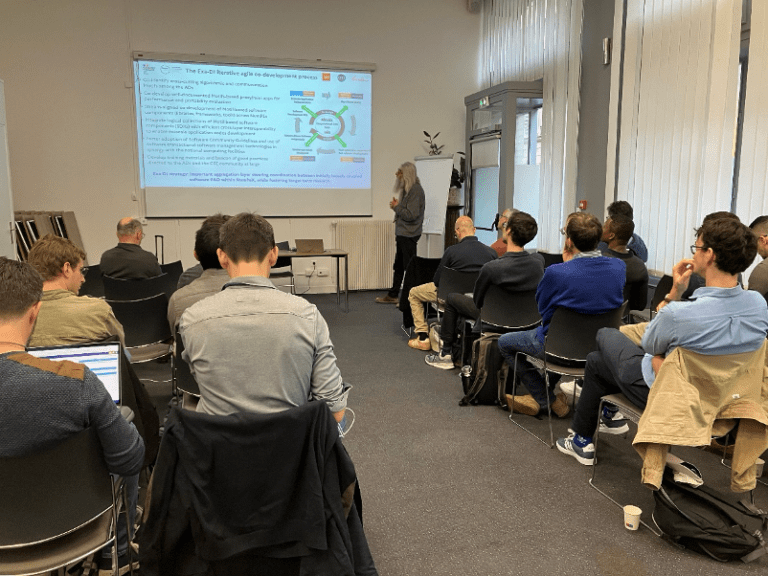
Exa-DI General Assembly on “Implementing Agile ways of working”, Part II
Organized by Numpex
Exa-DI
Workshop Exa-DI Organized by Numpex
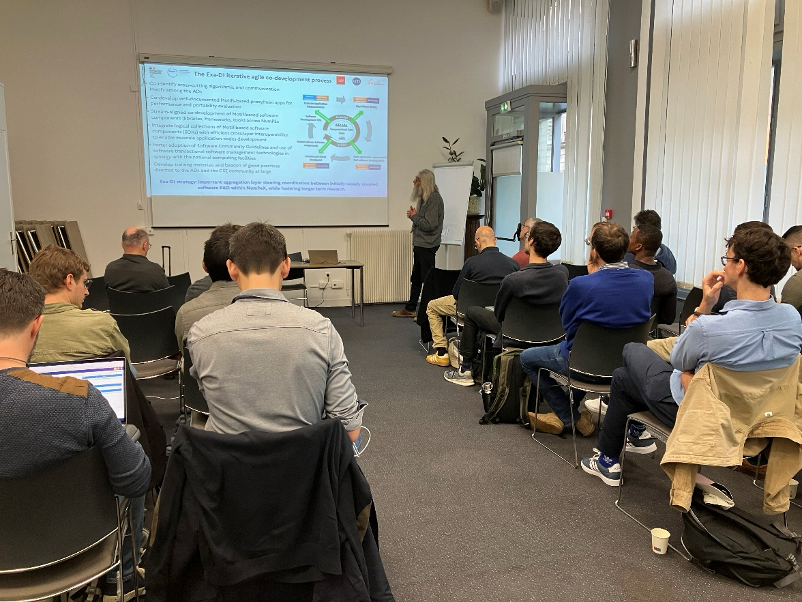
Co-design/co-development workshop on “Artificial Intelligence for HPC@Exascale”
Organized by Numpex
Exa-DI
General Assembly Exa-DI Organized by Numpex
Exa-DI General Assembly on “Implementing Agile ways of working”, Part I
Organized by Numpex
Exa-DI
Training / Tutorial Exa-DI Organized by Numpex
Tutorial @ Compass25: Guix-deploy
Organized by Numpex
Exa-DI Exa-DoST
Training / Tutorial
Training on Parallel IO et in situ Analytics : High-performance data handle @ Exascale
Training / Tutorial Exa-DI Exa-DoST Organized by Numpex
Training on Parallel IO et in situ Analytics : High-performance data handle @ Exascale
Co-organization with Maison de la Simulation/CEA and Exa-DoST/NumPEx.

Organized by Numpex
Exa-AToW Exa-DI Exa-DoST Exa-MA Exa-SofT NumPEx

Conference Exa-AToW Exa-DI Exa-DoST Exa-MA Exa-SofT NumPEx Organized by Numpex
2024 Teratec Forum
The TERATEC Forum is a major event in Europe that brings together the best international experts in high-performance computing (HPC) in digital simulation, high-performance computing (HPC), massive data processing, artificial intelligence and quantum computing. And NumPEx members are excited to be part of this communit…
Organized by Numpex
Exa-DI
Workshop Exa-DI Organized by Numpex
Block-structured AMR @Exascale workshop
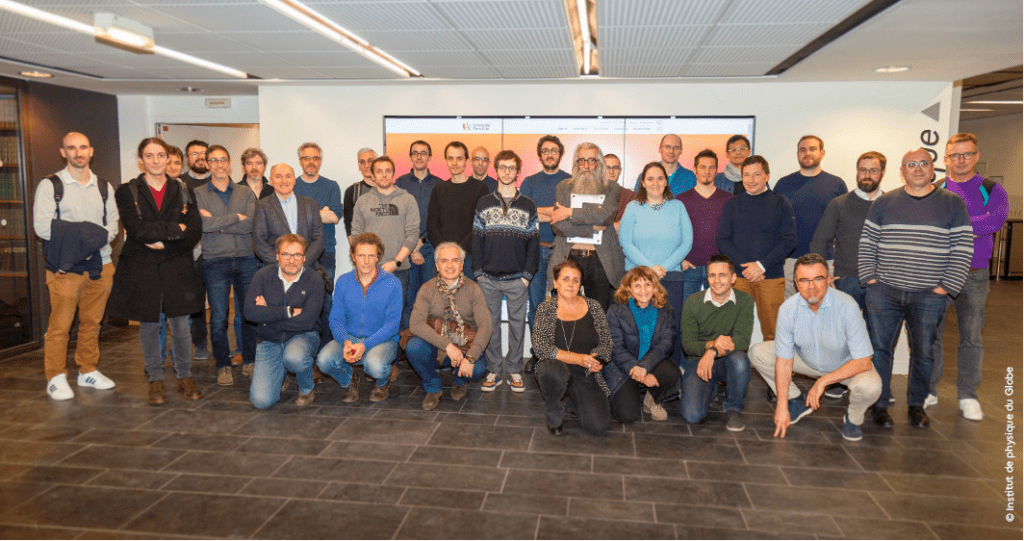
The second co-design/co-development workshop of the Exa-DI project (Development and Integration) of the PEPR NumPEx is dedicated to the computation and communication motif “Block-structured AMR @Exascale”. It will take place on February 6 and 7, 2024 at the “Grand Amphi” of the “Institut de Physique du Globe de Paris”…
Organized by Numpex
Exa-DI
Workshop Exa-DI Organized by Numpex
Co-design/co-development workshop on “Block-structured AMR@Exascale”
Organized by Numpex
Exa-DI
Workshop Exa-DI Organized by Numpex
Co-design/co-development workshop on “Efficient Discretisation for PDE@Exascale”
Organized by Numpex
Exa-DI
Workshop Exa-DI Organized by Numpex
Efficient Discretisation for PDE@Exascale Workshop
The first co-design/co-development workshop of the Exa-DI project (Development and Integration) of the PEPR NumPEx will be the perfect opportunity to discuss about “Efficient Discretisation for PDE@Exascale”. The workshop will take place on November 7 and 8, 2023 at the Amphithéâtre J. Talairach (Neurospin) at CEA Sacl…
Organized by Numpex
Exa-AToW Exa-DI Exa-DoST Exa-MA Exa-SofT
General Assembly Exa-AToW Exa-DI Exa-DoST Exa-MA Exa-SofT Organized by Numpex
Kick-Off NumPEx
Organized by Numpex
Exa-DI
Workshop Exa-DI Organized by Numpex
Workshop on Software integration and delivery, transactional software packaging and deployment technologies
No past event matches these filters.
News
Exa-DI latest news

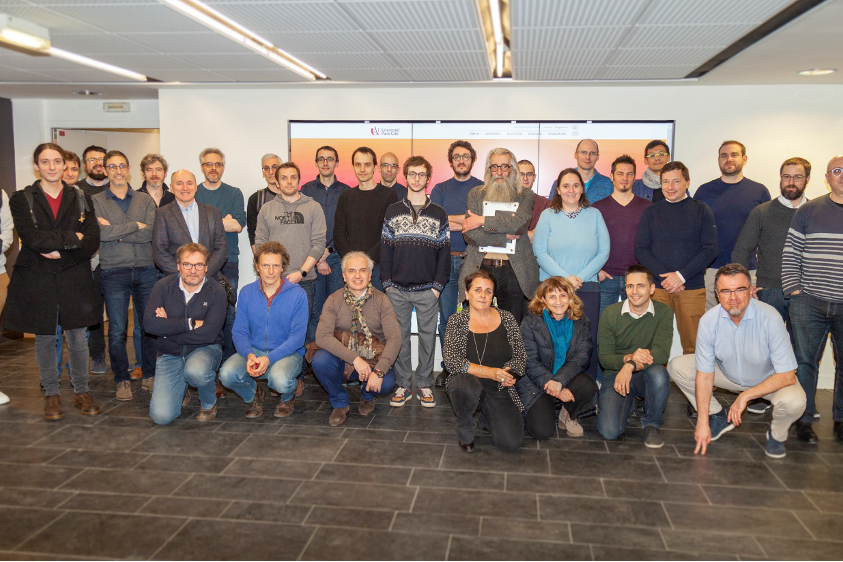

The Team
The Exa-DI Team
Discover the members

Jean-Pierre Vilotte
WP1 co-leader
CNRS Research director
Scientific Deputy at CNRS Earth & Space

Valérie Brenner
WP2 co-leader · Project Officer
CEA Research director
Maison de la Simulation (Mdls — CEA/CNRS/Université Paris-Saclay/Université Versailles Saint-Quentin)

Jérôme Bobin
NumPEx co-director
Research director CEA
Institute for Research on the fundamental laws of the universe (CEA Irfu)

Bruno Raffin
WP3 co-leader
Inria research director
Inria Grenoble — DataMove joint research team (Inria, LIG — CNRS/Inria/Université Grenoble Alpes)

Julien Bigot
Exa-DoST co-leader
CEA research scientist
Maison de la Simulation

Benoît Martin
WP3 co-leader · liaison with Exa-DoST
CEA research scientist
Maison de la Simulation (Mdls — CEA/CNRS/Université Paris-Saclay/Université Versailles Saint-Quentin)

Jérôme Charousset
Program Manager of Exa-DI
CEA research engineer
Institute for Research on the fundamental laws of the universe (CEA Irfu)

Ludovic Courtès
Inria research engineer
Inria Bordeaux
Félix Kpadonou
CEA research engineer
Institute for Research on the fundamental laws of the universe (CEA Irfu)

Benoit Malézieux
CNRS research scientist
Maison de la Simulation (Mdls — CEA/CNRS/Université Paris-Saclay/Université Versailles Saint-Quentin)

Aurélien Dauteuil
CEA research engineer
Institute for Research on the fundamental laws of the universe (CEA Irfu)
Pierre Neyron
CNRS research engineer
Computer Science Laboratory of Grenoble (LIG)

Thomas Bouvier
CEA research engineer
MdlS

Dinh-Triem Phan
CNRS research engineer
MdlS

Alexandre Roget
CNRS research engineer
MdlS

Sergio Pastor Perez
Inria research engineer
Inria Bordeaux
Iole Bolognesi
CNRS research engineer
MdlS
Vivien Krauss
CNRS research engineer
Inria Bordeaux
Romain Margheriti
CEA research engineer
Institute for Research on the fundamental laws of the universe (CEA Irfu)
Working Group leaders
Contact Us
Stay in contact with Exa-DI
Leave us a message, we will contact you as soon as possible