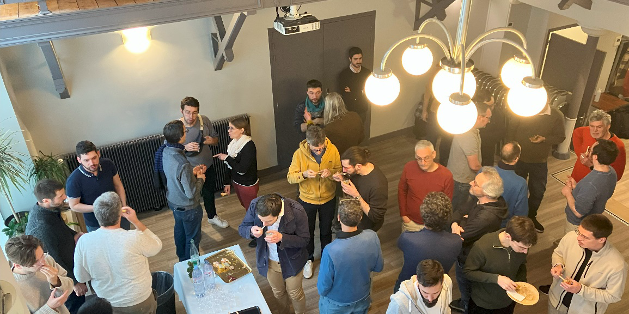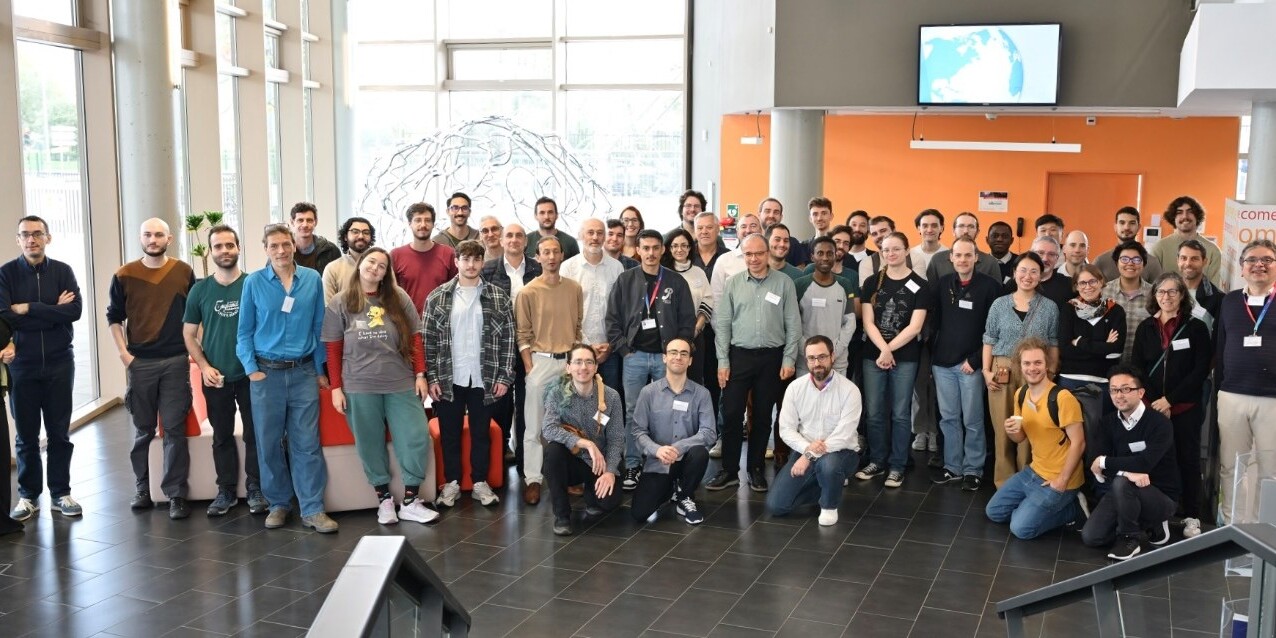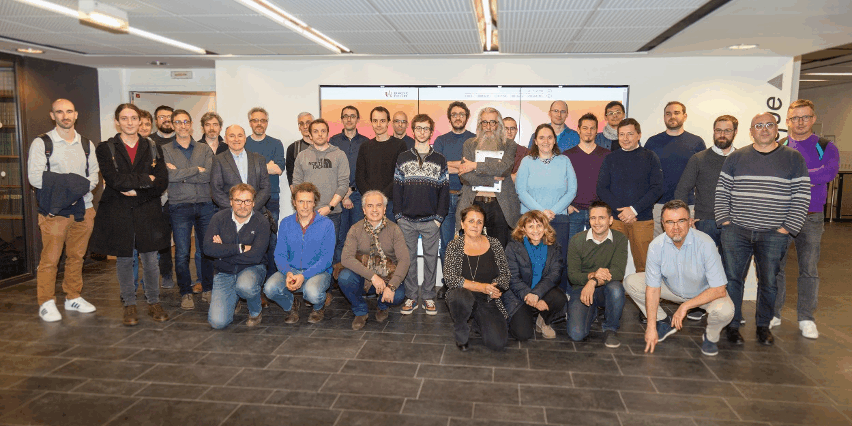


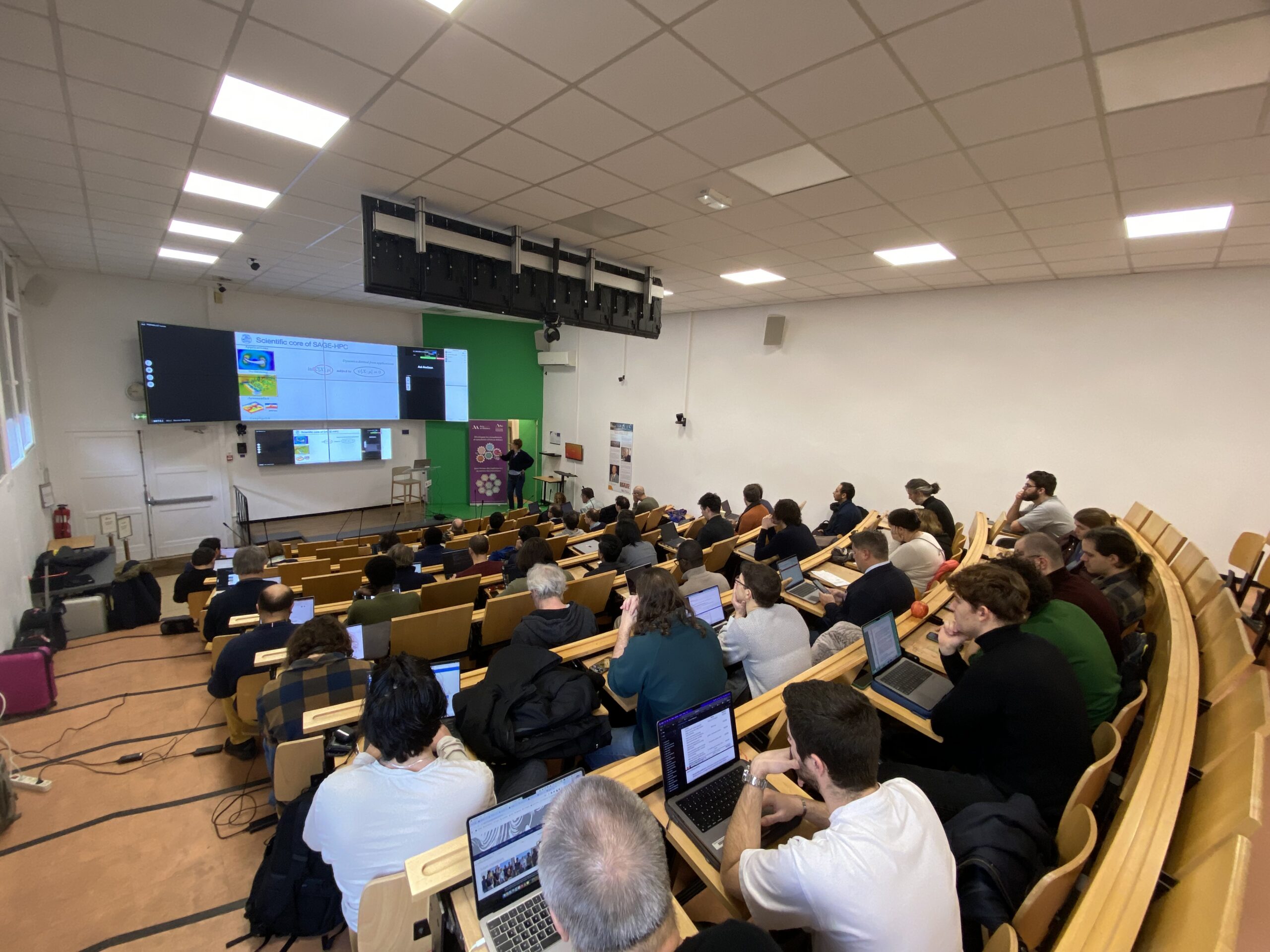
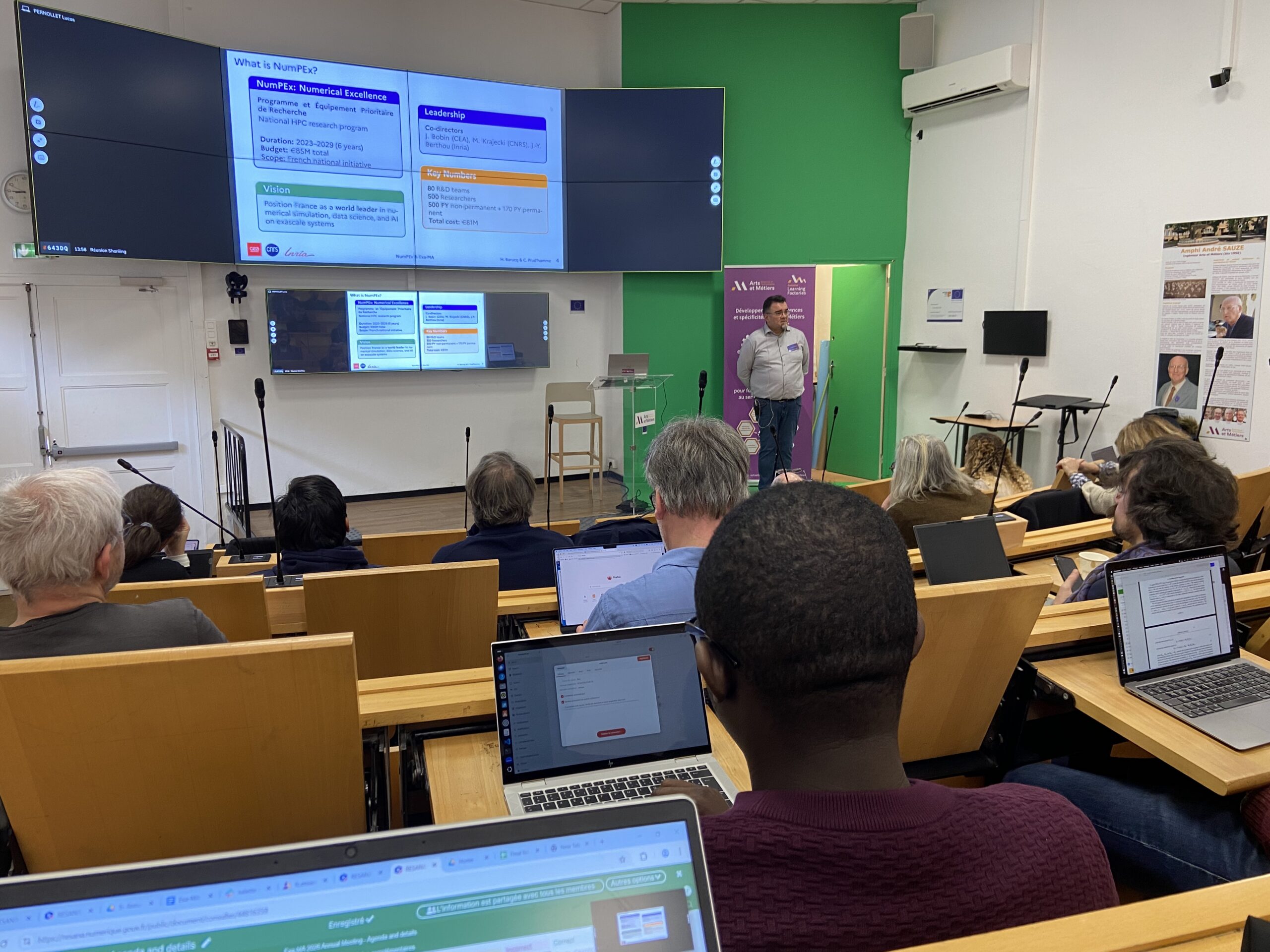
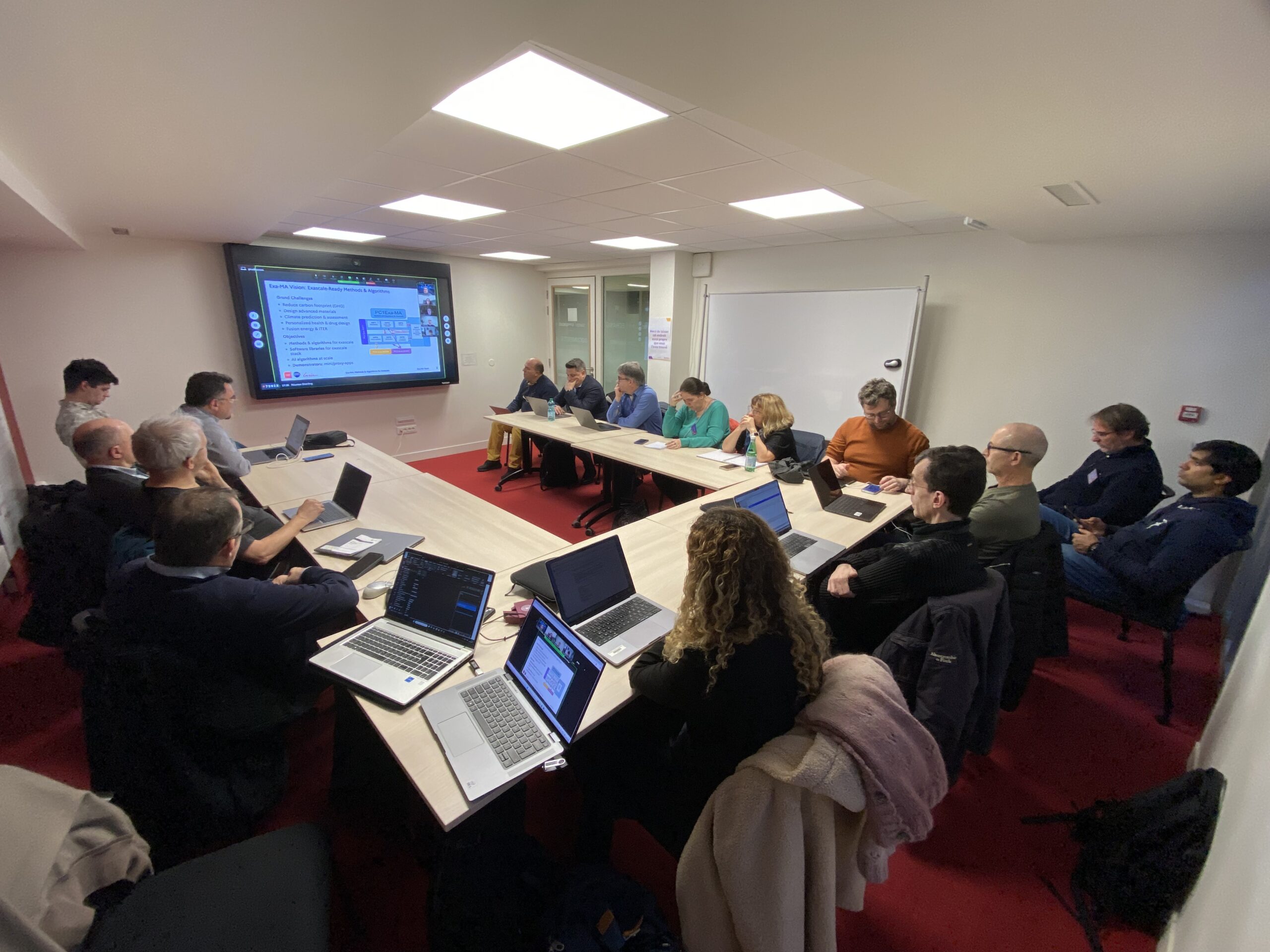
The 2026 Exa-MA Annual Assembly held at Arts et Métiers ParisTech (Aix-en-Provence) from 19 to 21 January, 2026, highlighted the project’s central role in France’s NumPEx initiative. It focused on preparing the software stack for the “Alice Recoque” exascale supercomputer.
Exa-MA aims to revolutionize methods and algorithms for exascale scaling: discretization, resolution, learning and order reduction, inverse problem, optimization and uncertainties. We are contributing to the software stack of future European computers.
The 3rd Exa-MA General Assembly highlighted the project’s central role in France’s NumPEx initiative, preparing the software stack for the “Alice Recoque” exascale supercomputer. Key discussions focused on 2026 priorities: GPU portability, AI-driven HPC convergence, and real-time neural operators, with applications in fusion energy, climate modeling, and aeronautics. The assembly emphasized delivering sovereign, open, and reproducible solutions, while addressing challenges like AI reliability in HPC and GPU acceleration. By expanding training and demonstrators, Exa-MA is reinforcing its “French model” of collaborative innovation, bridging AI and HPC for measurable scientific and societal impact.
Monday, 19 January 2026
- General presentation of NumPEx & Exa-MA
- Presentations of WPs: progress made + scientific highlights + next steps
Wednesday, 21 2026
- Presentation of Sage-HPC (AI for HPC)
- Presentation of Daimos (HPC for AI)
- Feedbacks from WPs (intra-WP meetings + breakout sessions with frameworks):
Attendees
- Emmanuel Agullo, Inria
- Pierre Alliez, Inria
- Amaury Bélières Frendo, Unistra
- Ani Anciaux Sedrakian, IFPEN
- Brieuc Antoine dit Urban, Inria
- Juliette Antonczak, Unistra
- Mark Asch, Université de Picardie
- Hassan Ballout, Unistra
- Helene Barucq, Inria
- Jerome Bobin, CEA
- Jed Brown, University of Colorado
- Filippo Brunelli, Inria
- Ansar Calloo, CEA
- Xinye Chen, Sorbonne Université
- Javier Cladellas, Unistra
- Susanne Claus, ONERA
- Ariel De Vora, CEA
- Mohamed Doumbouya, Inria
- Pierre Dubois, CEA
- Mahmoud El khadiri, Inria
- Erik Fabrizzi, Sorbonne Université
- Vincent Faucher, CEA
- Emmanuel Franck, Inria
- Josselin Garnier, Ecole Polytechnique
- Clément Gauchy, CEA
- Christophe Geuzaine, Université de Liège
- Laetitia Giraldi, Inria
- Loic Gouarin, Ecole Polytechnique
- Arthur Gouinguenet, Inria
- Virginie Grandgirard, CEA
- Julien Herrmann, Inria
- Alexandre Hoffmann, Ecole Polytechnique
- Remy Hosseinkhan, Ecole Polytechnique
- Daria Hrebenshchykova, Inria
- Bertrand Iooss, EDF
- Vincent Italiano, Unistra
- Utpal Kiran, CEA
- Félix Kpadonou, CEA
- Philipp Krah, CEA
- Stéphane Lanteri, Inria
- Romain Le Tellier, CEA
- Benoît Malézieux, CEA
- Gilles Marait, Inria
- Jean-Baptiste Mascary, ANR
- Lois McInnes, Argonne National Laboratory
- Victor Michel-Dansac, Inria
- Mahamat Hamdan Nassouradine, CEA
- Frédéric Nataf, Sorbonne Université
- Laurent Navoret, Unistra
- Lars Nerger, Alfred Wegener Institute
- Augustin Parret-Fréaud, Safran
- Lucas Pernollet, CEA
- Raphaël Prat, CEA
- Christophe Prud’homme, Unistra
- Isabelle Ramière, CEA
- Yves Robert, ENS
- Mael Rouxel-Labbe, Geometry Factory
- Gianluigi Rozza, SISSA
- Eric Savin, ONERA
- Lukas Spies, Inria
- Alexandre Tabouret, Sorbonne Université
- El-ghazali Talbi, Université de Lille
- Tom Caruso, Inria
- Sébastien Tordeux, Inria
- Arthur Vidard, Inria
- Jean-Pierre Vilotte, CNRS


© PEPR NumPEx
NumPEx Newsletter
Subscribe to our newsletter to stay informed on the latest breakthroughs in High-Performance Computing, Exascale research, and cutting-edge digital innovations.