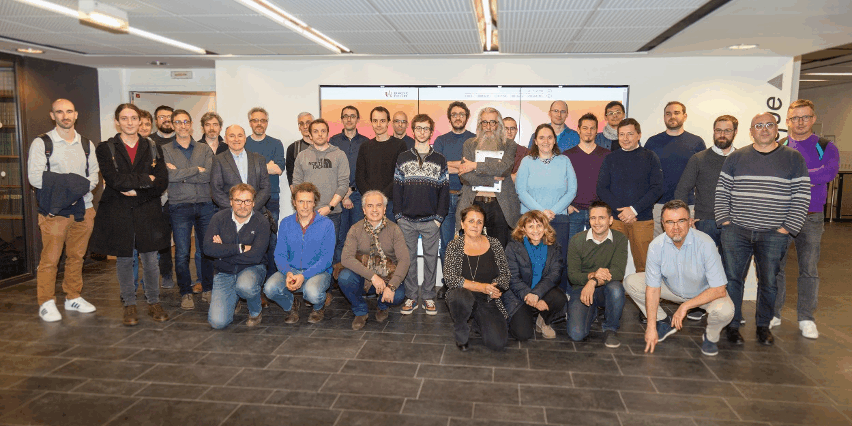
Alfredo Buttari and Théo Mary, both NumPEx members, now lead the research network Computing: Paradigms, Parallelism, Performance, Precision (Groupement de recherche C4P).
The field of computing in computer science is undergoing rapid and disruptive changes, both at the conceptual and technological levels and in terms of the application needs of the academic and private sectors. In this context, the creation of the Research Group (GDR) Computing: Paradigms, Parallelism, Performance, Precision (C4P, pronounced [kap]) is motivated by the need to unite, structure and animate the French scientific research community in the field of computing in the broadest sense.
Computing, a field undergoing rapid transformation
The largest supercomputers have now reached exaflop scale (a speed of 1018 floating point operations per second). However, their extremely complex architecture is characterised by a very high level of parallelism and a high degree of heterogeneity in terms of computing units, memory and communication channels. Similarly, energy consumption has become a major concern, as the power consumption of these large computing infrastructures can reach several tens of megawatts.
Furthermore, while numerical simulation applications were the main use of computing centres for several decades, artificial intelligence, and more specifically machine learning, has recently come to occupy an increasing share of computing infrastructure resources. This discipline has experienced a veritable explosion in recent years, thanks in particular to the availability of computing resources that enable the training of very large models that now include billions of parameters.
Significant challenges:
In this context, marked by rapid technological changes that sometimes break with past approaches, scientific research in the field of computing is evolving. It faces significant challenges at several levels, from hardware and software to data management and numerical methods and algorithms. This can be summarised by the four ‘Ps’ in french:
Paradigms: Design and develop emerging paradigms, such as quantum, neuromorphic, molecular, or in-memory computing, to overcome the limitations of von Neumann architecture and the end of Moore’s Law through more efficient, parallel, and frugal computing models.
Parallelism: designing and developing algorithms, programming models and computing software capable of scaling up on modern computing infrastructures equipped with numerous heterogeneous computing units, memories and communication channels.
Performance and energy: measuring, analysing and improving the performance of algorithms and computational software in terms of time, memory and energy consumption, taking into account the complexity and diversity of infrastructures and applications.
Accuracy and robustness: measuring, controlling and guaranteeing the accuracy and robustness of algorithms and computational software in the face of errors, in a context where the use of low-precision arithmetic is increasingly widespread and failures are increasingly likely.
Subscribe to our newsletter to stay informed on the latest breakthroughs in High-Performance Computing, Exascale research, and cutting-edge digital innovations.
At Numpex, we respect your privacy and are committed to protecting your personal data. We use cookies and other similar technologies to enhance your browsing experience, analyze site usage and comply with our Privacy Policy.